Event 1
Lestat's Wolf Hunt
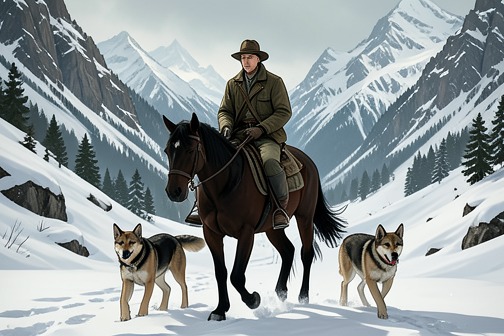
[Lestat's Wolf Hunt](entity:event-recall-event-lestat-s-wolf-hunt-3af889fe7af9) is the winter ordeal that first forces the young [Lestat](entity:character-recall-character-lestat-1e494e73e33c) to meet death not as an abstraction but as an immediate fact. Riding alone into the mountains of [Auvergne](entity:location-recall-location-auvergne-df7788427a46) to protect the village from a starving wolf pack, he survives a failed hunt that costs him his dogs and horse. The return with a dead wolf is both proof of his endurance and the beginning of a deeper crisis: the violence of the encounter follows him home, where his brother [Augustin](entity:character-recall-character-augustin-100d7b38f66c) challenges his account.
## Causes and Background
In the winter of his twenty-first year, Lestat rode out on his father’s land in Auvergne, [France](entity:location-recall-location-france-f5cafc8a8ad4), in the final decades before the [French Revolution](entity:time-recall-time-7fe2af46abc5). [Wolves](entity:creature-recall-creature-wolves-f665b9881f25) were taking the peasants’ sheep and even running through the village at night. The villagers counted five in the pack, and Lestat expected a battle. He brought guns, a flail, a sword, and two mastiffs he had bred and trained himself.
The hunt also arose from the narrow world in which Lestat had been raised. His father was a marquis, but the family’s wealth had dwindled; Augustin, the eldest brother and heir, had already spent his wife’s small dowry. As the youngest surviving son, Lestat had no claim to the title or land and few prospects. Hunting had become his private responsibility and a practical means of feeding the household during years when the family might otherwise have gone hungry. He was restless, angry, and dissatisfied with the old castle and its inherited stories, but in this landscape he was also the family’s provider.
## The Hunt Turns Against Him
Lestat wanted a direct fight, but the wolves controlled the encounter. Three came charging across the snow while five others emerged ahead of him, cutting off his route to the woods. The pack numbered eight, not five, and its coordinated approach turned what he had expected to be a hunt into an ambush.
Lestat first fought from horseback with his dogs beside him. He shot wolves while the mastiffs engaged the pack, but the animals were soon surrounded. Their spiked collars did not save them: one was brought down, and the second was killed as it tried to defend it. The dogs had been his trained companions and regular hunting partners; seeing them die made the danger plain to him in a way the initial rush had not.
The attack left Lestat fighting on foot. With one gun no longer available and the other weapons at hand, he faced the wolves rather than surrender. They circled and pressed him, tiring him over what he estimates may have been half an hour. When his legs were failing, he stood still and waited for their final approach. At the last moment he swung the flail, then used his broadsword to kill the wolf in front of him. He struck the other as it came at his side and finished it with the sword.
## Survival and Its Cost
The pack was dead, and Lestat was alive, but the encounter was not over. His mare lay dying nearby. He loaded his rifle and shot her through the heart, ending her suffering. The act brought the valley to stillness, but Lestat was left shuddering and barely able to walk. Rather than stop, he returned to the dead wolves, lifted the last one that had nearly killed him onto his shoulders, and began the trek home.
The animals in the hunt occupy distinct places in Lestat’s life: the mastiffs are his trained partners, the wolves are both a threat to the village and a coordinated force he has underestimated, and the mare is a dependent companion whose suffering requires a final decision from him. The hunt makes survival inseparable from loss. Lestat can kill the pack and still have to confront the deaths of the animals who accompanied him.
## Return and Immediate Aftermath
Back at the castle, Lestat tried to describe what had happened, but could scarcely get beyond a halting account. Augustin interrupted him, accusing him of having failed to kill eight wolves. As soon as he spoke, however, Augustin seemed to realize that he had made a mistake. The confrontation shifts the focus from the hunt’s physical outcome to the family’s strained response: Lestat’s return with the wolf does not bring simple recognition or comfort.
The hunt thus closes on two kinds of exposure. In the valley, Lestat discovers how vulnerable he is when the pack outmaneuvers him and his dogs are lost. At home, the story of that survival meets the contempt and misunderstanding already present in his family. It is a decisive early episode because the practical hunter’s work becomes an encounter with death that continues to shape Lestat after he has left the snow behind.
## Death as an Immediate Reality
The hunt’s aftermath reaches beyond the wolves’ deaths. Lestat’s description of the mare makes the animal’s suffering the encounter’s most intimate crisis: though badly injured, she repeatedly tries to rise, and he recognizes that nothing can be done to save her. He reloads his rifle and kills her, ending her suffering rather than leaving her to die slowly. This decision distinguishes the mare from the wolves, who were a danger to the village, and from the mastiffs, who fought at his side. Each animal occupies a different relation to him, but all make the cost of the hunt impossible to reduce to victory.
The stark contrast between the dead pack and Lestat’s survival does not leave him triumphant. He is shuddering, sick, and barely able to walk; even so, he takes the wolf that nearly killed him and starts home. The hunt therefore turns the young hunter’s familiar work into a confrontation with death as something irreversible and unresolved, a perception that later overwhelms him with fear of mortality. The encounter’s significance lies not only in surviving an ambush, but in carrying its consequences back into ordinary life.
## The Return and Augustin’s Challenge
Back at the castle, Lestat tried to recount the encounter but could scarcely get beyond a halting account. His family had risen from the table; his mother was patting his already-blind father, who wanted to know what had happened. Augustin broke into Lestat’s flat, uncertain narration and accused him of not having killed eight wolves. Almost as soon as he spoke, Augustin seemed to realize he had made a mistake. The scene gives the hunt an unsettled homecoming: Lestat returns alive with a wolf, but the achievement meets suspicion rather than uncomplicated recognition.
## The Hunt’s Place in Lestat’s Life
The hunt begins in the practical world Lestat knows: his family’s shrinking means had made hunting his private responsibility, and the game he brought home helped feed the household. That work had already made him a provider, but the wolves’ ambush breaks the familiar terms of the role. He goes out expecting to control the encounter and instead has to fight simply to survive. The loss of the mastiffs and the decision to end his mare’s suffering leave no uncomplicated victory to carry home.
That reversal gives the episode its lasting force. In the valley, survival means killing the pack; afterward, it also means confronting the deaths of the animals beside him and carrying one of the wolves back to the castle. Augustin’s challenge then turns the return into a social wound: the family receives neither a straightforward account nor an uncomplicated triumph. Lestat’s later terror of death is not confined to this hunt, but his memory of it gives that terror a concrete beginning in bodily danger and irreversible loss. The young hunter who had treated death as part of the work is left facing it as a reality that resolves nothing.
Event 2
Lestat's Crisis of Mortality
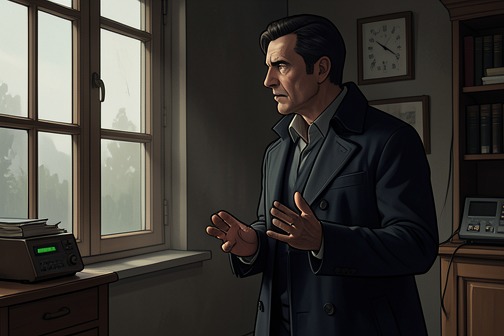
[Lestat's Crisis of Mortality](entity:event-recall-event-lestat-s-crisis-of-mort-a84da2a8ac7e) is a breakdown in which the prospect of death strips away the hope that suffering will eventually be explained or redeemed. It begins in conversation with Nicolas, becomes panic at the thought of a silent universe, and leaves [Lestat](entity:character-recall-character-lestat-1e494e73e33c) with no solution beyond a fierce, lasting gratitude for music and other beautiful things.
## Causes and Background
The crisis grows out of an exchange about art and the meaning of a human life. Lestat had been arguing that music and acting could drive back chaos: without them, daily existence seemed meaningless, and a life cut short might amount to nothing more. His mother’s impending death makes the question immediate. He tells Nicolas that she has said she is afraid, and recognizes that her death, like any other, might have no meaning or explanation.
The discussion turns from the value of art to the limits of what death can reveal. Lestat imagines that even an avowed atheist might expect an answer at the end—God, or at least confirmation that there is nothing. He then rejects both possibilities as consolation: death may simply end consciousness, without disclosing why life or the universe existed. In that realization, the hope of a final accounting gives way to the fear that no accounting will ever come.
## The Breakdown
Lestat pictures the sun, planets, and stars against an endless black night and laughs at the thought that the universe will remain unexplained. The laughter stops when he understands the force of what he is saying. There will be no judgment day or luminous revelation to set wrongs right; the witches burned at the stake will not be avenged, and no one will tell the living what it all meant. His language circles insistently around not knowing, giving the crisis the shape of a conclusion that cannot be escaped by argument.
The thought becomes physical panic. Lestat runs to the window, unlatches it, and swings open its heavy glass to stare at the stars. Unable to bear what he sees as their emptiness and silence, he roars. Nicolas pulls him back from the windowsill and shuts the window, then repeatedly assures him that he will be all right and urges him to sleep. An innkeeper, hearing the disturbance, beats on the door and demands to know why they are making such a noise. The room’s intimate philosophical exchange has become a public commotion that neither reassurance nor sleep can immediately contain.
## The Crisis Persists
The next day brings no relief, nor does the end of the week. Lestat continues to eat, drink, and sleep, but describes every waking moment as panic and pain. Seeking certainty, he goes to the village priest and demands to know whether the Body of Christ is truly present on the altar during the Consecration. The priest’s stammered answers and frightened expression leave Lestat more desperate rather than reassuring him. The encounter demonstrates that religious authority cannot supply the answer he demands.
Lestat asks how anyone can go on breathing, moving, and acting while knowing there is no explanation. Nicolas suggests that music might make him feel better and plays the violin. Lestat asks him to play again, calling the music innocent. He knows it will not cure the crisis or make him forget, but feels inexpressible gratitude that something so beautiful can exist amid the horror. Music does not solve the question; its force lies in remaining beautiful without pretending to answer it.
## Beauty Without Consolation
The same gratitude extends beyond the violin. Lestat is moved to tears by village children dancing, their bodies turning to the rhythm of their songs. In the church, he kneels against a wall and weeps over the carved fingers, faces, and deep folds in the garments of the ancient statues. He takes these made things as evidence of beauty and goodness, even while the larger order of existence seems indifferent and inexplicable.
That consolation is neither complete nor stable. Natural beauty, which might ordinarily offer comfort, now intensifies his distress: even the sight of a solitary tree in a field can make him tremble and cry out. His plea to fill the orchard with music gives the crisis a practical, artistic counterimage—not an explanation of the world, but a human act set against the mind’s terror of meaninglessness. The distinction between human-made beauty and nature’s unsettling vastness marks how radically his perception has changed.
## Ending and Significance
Lestat later says the crisis never really passed. Its ending is therefore not a recovery in which religious certainty replaces doubt or philosophical reasoning defeats fear. Instead, he remains aware that music and beauty cannot abolish the unanswered questions, while still experiencing them as precious. The episode leaves a lasting tension between the apparent indifference of the universe and the meaning people can make through art, performance, and attention to beauty.
The scene’s movement is from an argument about art’s power to a lived encounter with mortality: Lestat speaks, laughs, recognizes the implications, and finally cannot endure the stars at the window. Nicolas’s physical intervention and violin-playing offer care without claiming to refute the crisis. By making the breakdown persist beyond the immediate night, the episode establishes that beauty is not a cure or a final explanation; it is something Lestat can be grateful for even when neither is available.
Event 3
Lestat and Nicolas's Flight to Paris

[Lestat](entity:character-recall-character-lestat-1e494e73e33c) and Nicolas’s Flight to [Paris](entity:location-recall-location-657453741ed3) is the decisive escape from a life circumscribed by inheritance, family poverty, and a mother’s fear of losing her son. Lestat’s mother gives him the money she has left and urges him to go, transforming an uncertain plan into a departure they can no longer postpone. The two reach Paris within a fortnight, where the freedom they sought arrives not as security but as a garret, depleted funds, and work in a shabby boulevard theater. That precarious beginning becomes the ground on which Lestat discovers a life in the theater.
## Background and the Decision to Leave
Lestat’s desire to leave grows out of a position that offers neither inheritance nor a future of his own. Though born to a marquis’s family, he is the youngest of the three sons to reach manhood, with no claim to the title or land. The family’s wealth has already been squandered: his eldest brother, [Augustin](entity:character-recall-character-augustin-100d7b38f66c), has spent even his wife’s small dowry. On the estate in the [Auvergne](entity:location-recall-location-auvergne-df7788427a46), Lestat hunts pheasant, venison, and trout to feed the household, a solitary responsibility that in some years helps keep the family from starvation. His father’s castle, estate, and neighboring village form the limits of his world, one he has long found stifling.
An earlier prospect of religious education narrows rather than opens his choices. Augustin explains that Lestat was sent to learn reading and writing, not to pursue a church career worthy of his rank: the family cannot finance a path to a bishopric or cardinalate. The expected alternative is to remain at home, illiterate and dependent, and to consider duties to his nieces and nephews. Lestat breaks down at supper, calling the household “chaos,” and is sent back to his room. Paris represents a chance to escape this imposed life, though not a promise of a stable livelihood.
The immediate decision is made in a quiet room by the hearth. Lestat’s mother knows that he and Nicolas are planning to run away; Nicolas’s father has also learned of the plan after the innkeeper overheard them. Rather than insist that Lestat stay until her death, she tells him to take the money left from her own family and go to Paris. She wants to know he is there and free when her time comes, and admits that she has kept him at home out of selfishness as well as pride. She will accept whatever work he and Nicolas can find, whether performing with Nicolas’s violin or turning somersaults at the St. Germain fair. Her blessing makes the departure an act of release as well as escape.
## Departure and Arrival
Lestat’s mother insists that the escape happen at once. He is to take the diligence at dawn and write when he reaches Paris. Because he cannot write for himself, she directs him to find an Italian letter writer at the cemetery of [Les Innocents](entity:location-recall-location-les-innocents-8fc8be813cd8), near the St. Germain Market, and dictate in Italian so that only she will be able to read his letter. This practical instruction joins the intimacy of their parting to the material circumstances that have shaped Lestat’s life: he has been denied an education, yet is now leaving to make a future beyond his family’s reach.
Once his mother leaves, the familiar objects in Lestat’s room briefly fix the scale of what he is abandoning: a straw mattress, two coats, a red cloak, one pair of leather shoes, and the mountains beyond a narrow window. Then he rushes down the stairs and the mountain to find Nicolas. Nicolas is watching a bonfire with his family. Lestat pulls him away from the crowd and the blaze and tells him to get his violin and play a song about their journey to Paris. Nicolas answers by pretending to play an invisible violin and asking how they will feed themselves there; Lestat refuses to let the question delay them. They leave in the morning.
Less than a fortnight later, Lestat is standing in the crowded public cemetery of Les Innocents, with its old vaults and open graves, dictating his first letter to his mother. He reports that he and Nicolas have arrived safely, found rooms on the Île de la Cité, and are happy in a Paris that seems warm, beautiful, and magnificent. The place where he writes is at once a cemetery and a bustling marketplace, an image of the strange, vivid world into which the escape has delivered him. He wishes he could hold the pen himself, but the letter still carries the essential news: the son who could not write at home has crossed into a life of his own.
## A Theatrical Life in Poverty
Lestat gives his mother the good news that he has been hired at a real theater to study acting and may soon perform. The claim conceals the harsher terms of their arrival. He and Nicolas climb six flights of stairs to their rooms, while men and women brawl and scream in the alley below. Lestat has spent their money taking Nicolas to operas, ballets, and dramas, and they have already run short. His job is at a shabby boulevard theater, barely above a fairground platform: he helps the players dress, sells tickets, sweeps, and throws out troublemakers.
Yet Lestat experiences the theater as a kind of paradise. He and Nicolas share a garret made glorious by a single tallow candle, cheap wine, and a loaf of fine Parisian bread. When money is especially tight, Nicolas plays violin solos on the boulevard while Lestat holds out a hat. The work is humble and the circumstances insecure, but the theater gives Lestat an absorbing world of performance and companionship. For five or six hours each evening, he lives among actors and workers who shout, laugh, quarrel, and struggle together. Their closeness is not founded on universal friendship; it comes from being comrades in the wings, bound to the same confined, turbulent enterprise.
The theater’s place in Paris helps explain both Lestat’s opportunity and his social dislocation. The [Comédie-Française](entity:organization-recall-organization-com-die-fran-ais-83f46a9aebc1) and the Théâtre des Italiens are the only government-sanctioned theaters, and serious tragedy and comedy belong to those houses. The old Italian commedia, with figures such as Pantaloon, Harlequin, and Scaramouche, survives at fairs alongside acrobats, jugglers, tightrope walkers, and puppeteers. The permanent boulevard theaters have grown from those fairground spectacles. Though they serve audiences unable to afford the grand houses, their lively performances also attract aristocrats and wealthy bourgeois spectators, offering a less formal alternative to the works of Racine and Voltaire.
## Class, Friendship, and the Life Ahead
Paris does not erase Lestat’s noble birth, but he chooses not to trade on it. He drops the name de Lioncourt in favor of the simple Lestat de Valois, which means nothing in particular, and the actors do not know his family background. The choice allows him to enter the theater through practical labor rather than inherited status. It also sharpens the contrast between his new life and the assumptions of Nicolas’s prosperous student friends, who regard Nicolas’s circumstances as madness and have no words for seeing a nobleman dress actresses and empty slop buckets.
Lestat is eager to learn. He memorizes, mimics, and asks questions, absorbing whatever the stage can teach him. Each night, that education pauses for Nicolas’s violin solo: Nicolas rises from his place in the tiny orchestra, is picked out by the spotlight, and plays a short sonata that brings down the house. The performance preserves a central part of their shared life even as their fortunes diverge—Nicolas contributes music, while Lestat pursues acting and works his way through the theater’s daily labor.
The route to Paris thus opens freedom without resolving the conditions that made escape necessary. The bourgeois spectators who aspire to aristocratic status are, in Lestat’s telling, caught up in the Revolution that abolishes the class they hoped to join. Later, news reaches him that on July 14 the Parisian mobs attacked the Bastille and that rebellion has spread through [France](entity:location-recall-location-france-f5cafc8a8ad4); peasants and tenant farmers have risen against his father’s house, killing his brothers, their wives and children, and the castle’s defenders. His father alone escapes and reaches [New Orleans](entity:location-recall-location-new-orleans-ac6617a07d7e), asking Lestat to come to his aid. The journey to Paris first frees Lestat from the family estate, but the Revolution eventually makes that departure inseparable from the violent destruction of the world he left behind.
Event 4
Lestat's Acting Debut in Paris
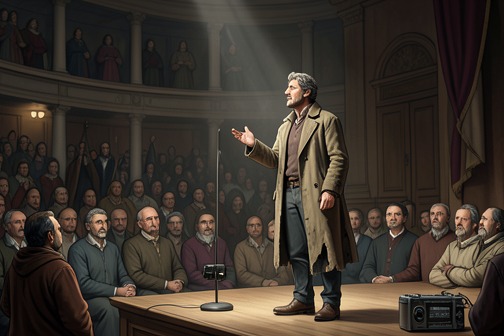
[Lestat's Acting Debut in Paris](entity:event-recall-event-lestat-s-acting-debut-i-ee07d9f67193) is the moment his childhood talent for improvisation becomes a public career. In late August, playing Lelio opposite Flaminia at a crowded boulevard theater, he discovers that the stage can transform fear into command: the audience rises to applaud, and manager [Renaud](entity:character-recall-character-6a83719fd50c) agrees to hire him as a regular actor, with the troupe insisting he be paid for his work rather than made to sweep and mop.## Background: From a Displaced Heir to a Player
The debut grows out of a life with few respectable prospects. [Lestat](entity:character-recall-character-lestat-1e494e73e33c) was the seventh son of a Marquis, one of only three sons to reach manhood, with no claim to the title or land. His family’s wealth had dwindled, and his eldest brother [Augustin](entity:character-recall-character-augustin-100d7b38f66c), heir to the estate, had already spent his wife’s modest dowry. The castle and nearby village formed Lestat’s entire world; there he hunted pheasant, venison, and trout to help keep the family from starvation. That practical role did not satisfy his restless, angry temperament or his impatience with the old stories of the Sun King.
His family’s plans for his education sharpened the sense of confinement. He had been sent to learn to read and write, but Augustin made clear that there was no money to launch a younger son into a church career befitting the family’s rank. Lestat understood the arrangement as a sentence to remain in the household, without prospects, and wept at supper, calling the house chaos. Acting offered a different possibility: a life made through invention rather than inheritance.
The first decisive encounter came with a traveling company performing commedia dell’arte. Lestat loved the players’ speed and vitality, and learned that their characters had enduring roles while their words and actions were improvised afresh each night. After buying them wine at an inn, he examined their costumes and painted scenery, then tried the role of Lelio, the young lover of Isabella. The actors applauded and told him he had the gift. The [Paris](entity:location-recall-location-657453741ed3) debut would return him to that role, but before an audience whose response could change his material circumstances.
## The Paris Theater and Its Rules
By Lestat’s time, boulevard theaters had become permanent establishments along [Boulevard du Temple](entity:location-recall-location-boulevard-du-temple-b626334624eb), evolving from the fairground entertainments where commedia, acrobatics, juggling, and puppetry had flourished. They were not government-sanctioned theaters. Serious drama, including tragedy and comedy by Racine, Corneille, and Voltaire, belonged by regulation to the [Comédie-Française](entity:organization-recall-organization-com-die-fran-ais-83f46a9aebc1) and the Théâtre des Italiens. Boulevard companies therefore relied on Italian comedy, songs, and comic spectacle rather than straight plays that might violate the state theaters’ monopoly.
That restriction shaped the craft and the evening’s atmosphere. Lestat’s company performed improvised Italian comedy, making each night different in detail but familiar in form, and mixed it with singing and nonsense. Their theater was a rickety wooden building with room for no more than three hundred, though its small stage and props were elegant, its curtain blue velvet, and its private boxes screened. Aristocrats and wealthy bourgeois joined poorer spectators in the audience, drawn by the lively performances and their contrast with the stiffness of the prestigious houses.
For Lestat, this was not merely an employment setting. He spent five or six hours each evening among actors who shouted, laughed, quarreled, and cooperated backstage, describing their shared life as a small boat at sea whose occupants could not escape one another. He studied the performers, memorized and mimicked, asked questions, and waited on them. His former identity as [Lestat de Lioncourt](entity:character-recall-character-lestat-de-lioncourt-0acd1217f0bb) receded: among the actors he used the simpler name Lestat de Valois, while the troupe knew nothing of his family. Each night Nicolas’s violin solo supplied another point of anticipation, but Lestat’s own hoped-for moment was to be called on as Lelio.
## The First Performance
The opportunity came in late August, during a warm Paris evening when the theater was full and the audience fanned itself with handkerchiefs and handbills. Lestat’s white stage paint was melting; he wore a pasteboard sword and Nicolas’s best velvet coat. Before going on, he trembled and compared the feeling to waiting for execution. But when he stepped into view and faced the packed hall, the fear evaporated. The change is immediate: the body that had been braced for danger becomes the instrument of a performance.
As Lelio, he bowed slowly, fixed his attention on Flaminia as if seeing her for the first time, and began the comic-romantic romp. The stage felt like his again, as it had in the country town years earlier. He and Flaminia quarreled, embraced, and clowned across the boards; laughter rolled through the house. Lestat felt the audience’s attention as an embrace, and each gesture and line drew another roar. The other actors eventually hurried the pair toward the wings so the next comic trick could begin, but the spectators were on their feet, calling for Lelio and Flaminia to return.
Backstage, Lestat reeled and nearly collapsed, unable for a moment to see anything except the image of the crowd looking up at him over the footlights. He wanted to go straight back onstage. He grabbed Flaminia and kissed her; she kissed him passionately in return, before Renaud pulled her away. The applause had carried the scene beyond the stage’s rehearsed playfulness into an encounter with the audience’s collective desire, while the kiss briefly made the role’s courtship personal.
## Hiring and Significance
Renaud told Lestat that he had done tolerably well and would be allowed to perform regularly. The troupe immediately pressed for more: Luchina argued that the boulevard’s handsomest actor should be hired outright and paid outright, not kept to sweeping floors or emptying mops and buckets. Lestat feared that the demand might end his new career before it began, but Renaud accepted the terms. The debut therefore changes not only his standing before the audience but also his place within the company, from an eager, unpaid helper to a performer whose labor is recognized and compensated.
The praise of his appearance mattered, but Lestat understood that it could not be enough. Lelio, the lover, required style, and Lestat’s aristocratic bearing suited the part; nevertheless, he wanted audiences—and even the actors of the Comédie-Française—to speak of him as more than a handsome young man fallen from a Marquis’s family onto the stage. He resolved to become a great actor. His debut is thus both an arrival and a beginning: the applause confirms a rare facility for performance, while the new ambition turns that gift into a demanding artistic objective.
The scene also gives a social frame to his self-invention. The boulevard drew aristocrats and rich bourgeois, some of whom aspired to aristocratic status even as they became caught up in the Revolution that would abolish the class they wished to join. Lestat, born into a noble family whose money and prospects had failed, finds a livelihood in a theater that operates outside the official hierarchy of serious drama. The stage does not erase the old order, but it lets him act beyond the future prescribed for a younger son: for one night, and then as a paid regular, the former hunter and frustrated heir becomes Lelio by making the role live before a Paris audience.
Event 5
Magnus Turns Lestat
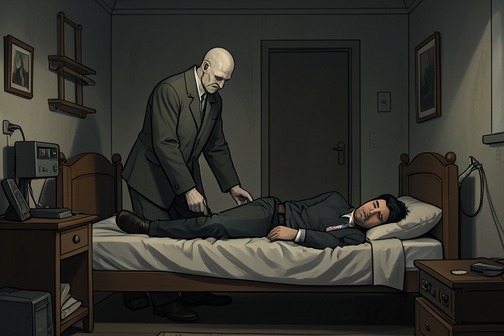
[Magnus Turns Lestat](entity:event-recall-event-magnus-turns-lestat-d0cf7914bb1a) is the abduction and transformation that ends [Lestat](entity:character-recall-character-lestat-1e494e73e33c)’s mortal life and begins his existence as a vampire. [Magnus](entity:character-recall-character-4069da87874e) first appears as an uncanny presence in the locked room Lestat shares with Nicolas; later, as Lestat lies near death, a vision reveals that Magnus himself was once mortal and stole immortality from a captive vampire. By giving Lestat his blood, Magnus makes him a vampire too, turning an encounter framed by terror and captivity into a bewildering experience of survival, power, and attachment.
## Abduction and Recognition
In the episode’s remembered sequence, Lestat wakes to find a tall figure standing over the bed he shares with Nicolas. The figure’s pale face is recognizable from the theater audience, but now the room’s locked door and Nicolas’s presence make the intrusion unmistakable. The figure calls Lestat [Wolfkiller](entity:expression-recall-expression-wolfkiller-65823514c1a4) without moving its lips. Lestat’s awareness of the visitor’s supernatural nature deepens as it draws nearer.
The abduction makes escape seem impossible. Lestat is carried over the rooftops and up the sheer face of a brick wall, then left on the roof of a small square tower. From there he sees [Paris](entity:location-recall-location-657453741ed3) spread below him, but the tower offers no higher place to reach and its edges drop hundreds of feet. The city remains visible while safety is out of reach: the open view does not mean freedom.
## The Name and the Hidden History
Lestat’s approach to this encounter has already been marked by the name Wolfkiller. In a dream of wolves, a voice speaks the name as both summons and tribute. When the figure later addresses him by it, the dream’s language becomes part of the waking encounter, linking Lestat’s past with the visitor’s knowledge of him. The scene does not explain how Magnus learned the name, but makes its use a sign of the reach and strangeness of his presence.
During the transformation, Lestat sees a vision that reveals Magnus’s history. In it, Magnus is still mortal, a powerful alchemist who has discovered a sleeping vampire in a catacomb and bound him in chains. Magnus drinks from the captive at dusk, taking the blood that makes him one of the living dead. The vision recasts the abductor: he is not an ancient vampire from the beginning, but a mortal who acquired immortality through an act of theft against a helpless immortal. Lestat’s own transformation echoes that earlier act, though Magnus gives his blood to him rather than taking it from an unwilling captive.
## The Turning
Magnus bites Lestat, who struggles against the experience, determined to resist. But resistance gives way to an altered state of pleasure and distance from the vampire’s ugliness. The remembered scene moves between Lestat’s stated defiance and his loss of control; the change is not presented as a decision he can simply make or undo.
As Lestat weakens, Magnus tells him he is dying. Lestat asks for help, and Magnus responds with an unexpectedly compassionate expression. He cuts his own throat and offers Lestat his blood. Lestat drinks desperately. He experiences the blood not merely as nourishment but as a force like light entering him, intensifying his desires even as Magnus’s strength visibly ebbs. The exchange reverses the immediate balance between captor and captive: Magnus supplies what Lestat needs to survive, while Lestat’s dependence makes the gift inseparable from the power Magnus holds over him.
## Consequences and Significance
After drinking, Lestat asks what Magnus has given him. His response joins horror and joy rather than resolving one into the other. In the transformation’s aftermath, divine authority seems remote to him, while the new condition he has entered feels like a center of life. The turning therefore changes not only his physical state but also the scale by which he understands existence: mortality has ended, but the survival offered by the [Dark Gift](entity:concept-recall-concept-dark-gift-8ccbb9152cb6) comes through an encounter he experiences as both violation and gift.
The event also anticipates the larger conflict over vampire secrecy. [Vampires](entity:creature-recall-creature-vampires-1d7f37af175a) hold as sacred the rule that their existence and the whereabouts of their lairs must not be disclosed to mortals. Later, Lestat discovers that [Louis](entity:character-recall-character-louis-b60a54ea5311), the narrator of [Interview with the Vampire](entity:object-recall-object-interview-with-the-vam-7b53a6f85e48), has told the story publicly, reaching hundreds of thousands of readers and seemingly pointing toward Lestat’s resting place in [New Orleans](entity:location-recall-location-new-orleans-ac6617a07d7e). That disclosure stands in sharp contrast to the secretive, personal origin of Lestat’s vampire life: his transformation began with a hidden abduction, a revelation about stolen immortality, and an exchange of blood that no human audience was meant to witness.
The episode also sits against competing accounts of vampire tradition. [Armand](entity:character-recall-character-a8d393c13b59) describes the [Rules of Darkness](entity:rule-recall-rule-rules-of-darkness-0808564fe307) as governing vampires who rise from the dead: they are to live among the dead, shun places of light, draw victims away from company, honor God and the sacraments, and never enter a church. Magnus’s history as an alchemist who seized immortality outside that inherited order helps distinguish his origin from those rules, while Lestat’s transformation under Magnus creates a new vampire through a personal act rather than the disciplined succession Armand describes. The scene’s lasting force lies in that contradiction: Lestat’s new life begins as an imposed encounter, yet he receives the blood as the fulfillment of a desire he cannot easily name or separate from his dependence on Magnus.
Event 6
Magnus's Self-Immolation
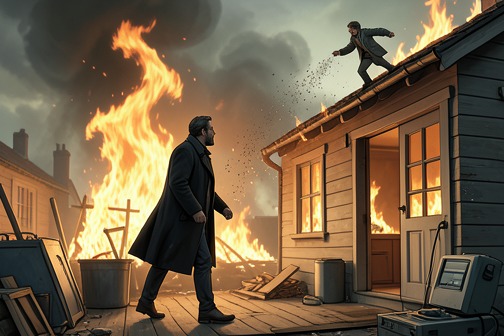
[Magnus](entity:character-recall-character-4069da87874e)’s Self-Immolation is the violent conclusion to Magnus’s transformation of [Lestat](entity:character-recall-character-lestat-1e494e73e33c) and the moment that leaves the newly made vampire alone with his maker’s house, treasure, and final command. Magnus steps into the flames by choice, but he does not make his departure simple: Lestat must scatter the ashes to prevent his return, then find the hidden coffin and shelter from the sun. The scene joins inheritance to terror, making Lestat’s first acts as an immortal a response to the death of the creature who created him.
## Background and the Making of an Heir
The scene’s cause reaches back to the vision Lestat experiences during his transformation. He sees Magnus as a mortal alchemist who has unearthed and chained a sleeping vampire in a catacomb, then drinks from his helpless prisoner at dusk. The vision frames Magnus’s acquisition of immortality as theft: he has taken the blood and power that will make him one of the living dead. That origin matters to the self-immolation that follows. Magnus is not a maker who intends to guide Lestat into a lasting fellowship; he has seized immortality for himself and now treats its continuation as a burden he can choose to end.
Before approaching the fire, Magnus names Lestat his heir. He says Lestat will take possession of the house and all the treasure, but only after doing what Magnus commands. The bequest is therefore not merely material. Magnus binds Lestat to the aftermath of his own destruction, giving the new vampire responsibility for his remains and instructions for surviving the days ahead. The transfer of authority occurs while Lestat is still overwhelmed by his changed senses and has only begun to understand what he has become.
## The Fire and the Command
When the logs begin to catch, Lestat recoils against the wall and insists that Magnus cannot enter the fire. His protest reveals how completely he has not yet assimilated the new rules of his existence: he sees the blaze as a danger no one could willingly choose. Magnus answers with laughter and insists that he can. In the firelight, Lestat sees his hands turn white and feels the pain of his eyeteeth growing into fangs. His transformation continues at the very moment he watches the being who made him prepare to die.
Magnus seizes Lestat’s wrist and sets out the conditions of his destruction. Once the fire has burned out, Lestat must scatter the ashes; otherwise Magnus might return, and Lestat would face a more hideous version of the same creature. Magnus threatens to hunt him down and burn him until he is scarred as Magnus is. The command makes the ashes a consequential boundary between death and possible return: leaving them undispersed would not secure an ending.
Magnus also explains how Lestat must survive. After scattering the remains, Lestat is to reach Magnus’s lair through a low passage, replace the stone behind him, and seal himself in a coffin by day. Sunlight will burn him to a cinder, Magnus warns; nothing on earth can end a vampire’s life except the sun or a blaze like the one before them, and even fire is final only if the ashes are scattered. Magnus’s last instructions turn the spectacle into practical knowledge, delivered as commands at the threshold of Lestat’s new life.
## Magnus’s Chosen End
Magnus’s speech presents his decision as a departure toward an unknown afterlife. He asks for the mercy of going to find hell, if it exists, or the oblivion he believes he does not deserve; if there is a Prince of Darkness, Magnus says, he will look upon him and spit in his face. This is not a quiet resignation. His language retains defiance even as he describes himself as leaving the world, and his laughter keeps interrupting the horror of the scene.
He sends Lestat stumbling away, then leaps high into the middle of the flames. Lestat sees the fire catch Magnus’s garments; his head seems to become a torch, and his body moves amid the blaze before the thin black limbs appear to wither. The laughter rises until Lestat’s cries drown it out. The fire finally shifts and roars, and there is nothing visible at its heart but flame. The scene withholds any easy dignity from the act: Magnus’s chosen death is at once a decision, a grotesque spectacle, and an event Lestat cannot bear to watch without crying.
## Ashes, Inheritance, and Consequence
After the fire dies, Lestat walks among the burned timbers. There are no bones, as though Magnus has disintegrated. Lestat gathers what ashes he can hold in his hands and takes them to the window; as the wind catches them, he whispers a farewell to Magnus, wondering whether he can still hear. He then wipes up the remaining soot and dusts it into the darkness. The scattering fulfills Magnus’s command and closes off the threatened possibility of his return, while requiring Lestat to perform the final act of separation himself.
The farewell is followed not by a return to ordinary life but by Lestat’s examination of the inner room. Magnus’s death thus leaves him to inhabit the inheritance at once: he must discover the lair and coffin described by his maker and adapt to the rules Magnus has disclosed. The emotional and practical consequences are inseparable. Lestat has received power and property, but the first legacy of that gift is solitude, a warning about the sun, and the task of ensuring that the ashes of his creator remain scattered.
## Narrative Significance
The event reverses the expected structure of a creator’s gift. Magnus names Lestat heir and gives him immortality, yet refuses the role of continuing mentor; he creates a successor and immediately removes himself, leaving a command in place of companionship. The new vampire’s first inheritance is therefore double-edged: a house and treasure on one side, a dangerous responsibility on the other.
The fire also makes Lestat’s transformation legible through contrast. While his fangs emerge and his body changes, Magnus’s body is consumed; one life begins in the same blaze that ends the other. The ashes carry the scene’s sharpest consequence: the fire alone does not guarantee finality, and Lestat must complete Magnus’s destruction by scattering what remains. In that labor, the maker’s last act becomes the fledgling’s first independent deed.
Event 7
Lestat's 1984 Awakening
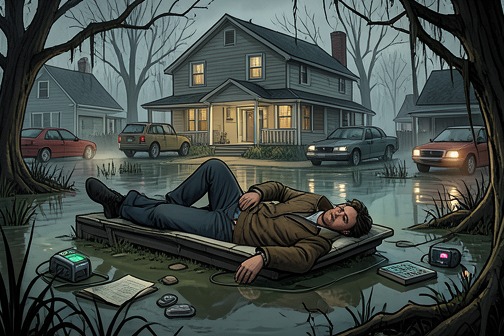
[Lestat's 1984 Awakening](entity:event-recall-event-lestat-s-1984-awakening-f20da3d71a67) marks the end of [Lestat de Lioncourt](entity:character-recall-character-lestat-de-lioncourt-0acd1217f0bb)’s decades underground and his return to active life in [New Orleans](entity:location-recall-location-new-orleans-ac6617a07d7e). It is not a single sudden revival: voices from modern media first reach him through a dreamlike state, while the music of Satan’s Night Out supplies the decisive impulse to rise. His emergence reunites his supernatural identity with a world transformed by technology, popular music, and new forms of public performance.
## Causes and Background
[Lestat](entity:character-recall-character-lestat-1e494e73e33c) had gone underground in New Orleans in [1929](entity:time-recall-time-1929-b17c225d85d1). During underground sleep, a vampire who stops drinking blood becomes too weak to revive himself and enters a dream state. The awakening account describes how that state gradually changed: radio broadcasts, phonograph records, and later television sounds reached him from cars and houses around the place where he lay beneath his own house on Prytania, near [Lafayette Cemetery](entity:location-recall-location-798379eaee28).
For much of the fifty-five years, he absorbed these sounds sluggishly, as though dreaming and responding to them with images. Over time, however, he began to follow entertainment programs and news, and to attend to song lyrics, rhythms, wars, inventions, and changing speech. The shift from passive reception to deliberate attention made him conscious that he was no longer dreaming. He understood that he was awake, buried, and starved for living blood, and began to wonder whether his old injuries had healed and his strength had returned, perhaps even increased.
The decisive stimulus came from Satan’s Night Out, a band of two male singers and one female singer who moved into a house on Sixth Street, less than a block from Lestat’s resting place. Their rehearsals began in [1984](entity:time-recall-time-1984-db6e36e8c14e). The electric guitars, urgent singing, pounding drums, and electric piano reached him underground; the piano’s sound reminded him of a harpsichord. He also caught thoughts that conveyed the musicians’ appearance and how they saw one another, registering them as young, slender, and androgynous mortals.
## The Impulse to Rise
The band’s music displaced many of the other amplified voices around him, and Lestat welcomed the change. Its combination of force and melody, and its technologically intricate performance, captivated him. He was especially struck by rock’s capacity to give voice to good and evil and to let performers present themselves as angels or devils before cheering audiences. To him, the music joined a seemingly barbaric energy to cerebral complexity, while its sustained electric notes and layered harmonies gave it a supernatural quality.
His response was at first more impulse than plan. He wanted to rise, join Satan’s Night Out, sing, and dance; he also imagined making the little-known band famous. The attraction was not merely to the musicians themselves but to a modern art form whose amplified sound seemed to make dread and spectacle newly audible. That fascination gave his returning awareness a direction: it turned the desire to learn whether he could rise into a desire to re-enter the living world.
## The Ascent and Return to Hunting
Lestat’s ascent took about a week. As he worked upward, he fed when he could on small animals beneath the earth, then summoned rats nearer the surface. From there he progressed to cats and eventually to a human victim, waiting until he found the kind of person he had chosen to prey upon: a man who had killed other mortals without remorse. The gradual ascent and selective feeding show that his return required both the recovery of physical capacity and the restoration of his strength through blood.
The modern environment initially unsettled him. Chemical and gasoline odors sickened him, while air conditioners and jet planes hurt his ears. Yet by the third night above ground he was riding a large black Harley-Davidson through New Orleans, seeking more killers to feed on. He wore black leather taken from his victims and listened to Bach’s Art of the Fugue on a Sony Walkman. The contrast between the motorcycle, portable stereo, and baroque music captures how readily his return combined contemporary technology with older tastes.
By the end of the first week, he declared himself the vampire Lestat again and New Orleans his hunting ground. His strength had returned to a level three times greater than before: he could leap from the street to a four-story roof, tear iron window gratings away, bend a copper penny, and hear human voices and thoughts from blocks off when he chose. He also began establishing himself in practical terms, obtaining a legal birth certificate, Social Security card, and driver’s license with help from a lawyer, while wealth held in coded accounts in the Bank of London and the Rothschild Bank was sent to New Orleans.
## Significance and Aftermath
The awakening makes technological sound an active force in Lestat’s return. Radio and television first teach him, slowly and indirectly, that history has continued during his burial; Satan’s Night Out then converts that accumulated awareness into a concrete wish to participate. The episode moves from listening in darkness to deliberate movement through the city, and from dreamlike uncertainty to a confident assertion of identity and renewed power.
The episode also establishes a significant tension between Lestat’s appetite for modern public culture and the secrecy expected of vampires. Later, at de Ville Books, he finds [Interview with the Vampire](entity:object-recall-object-interview-with-the-vam-7b53a6f85e48) and recognizes the danger posed by [Louis](entity:character-recall-character-louis-b60a54ea5311)’s public account: vampire law forbids revealing their existence, naming other immortals, or identifying their lairs to mortals. Lestat had already made a limited disclosure to the rock singers, but he sees Louis’s book as having reached hundreds of thousands of readers and potentially pointed them toward his resting place in New Orleans. Thus the emergence that begins with a wish to join a band leads into a broader confrontation between visibility and concealment.
Event 8
Lestat Discovers Interview with the Vampire
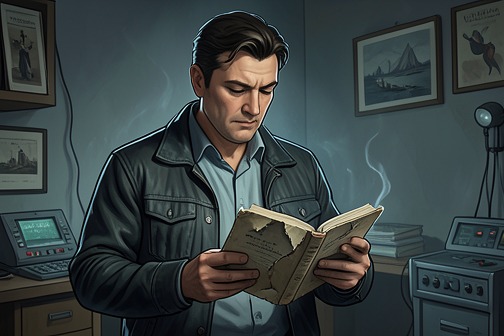
[Lestat Discovers Interview with the Vampire](entity:event-recall-event-lestat-discovers-interv-10f3821a5783) marks the moment when a battered paperback turns [Lestat](entity:character-recall-character-lestat-1e494e73e33c)’s private past into a public danger—and gives him a new reason to speak. After young musicians recognize his name from a book, he reads [Louis](entity:character-recall-character-louis-b60a54ea5311)’s account of their shared history, feels both anger and longing, and decides to answer it not simply with a rebuttal but with the story of the life that preceded Louis.
## The Book in the Musicians’ Hands
The discovery begins with [Alex](entity:character-recall-character-alex-ad819204cb8d), a young drummer, and his taller, blond-haired brother [Larry](entity:character-recall-character-larry-e4ec2b6e8fcf). When Lestat gives his name, the two recognize it and connect it to information they have read in a book. They are delighted that he presents himself as the particular vampire named Lestat, rather than pretending to be the familiar Count Dracula. Their reaction turns his own name into an unexpected point of contact between his real existence and a published account.
Lestat asks to see the book. The musicians bring him a small, deteriorating paperback: its binding is gone, its cover is torn, and a rubber band holds it together. The title, [Interview with the Vampire](entity:object-recall-object-interview-with-the-vam-7b53a6f85e48), produces a preternatural chill. From the cover and premise, Lestat understands that a mortal boy has persuaded one of the undead to tell his story. What initially reaches him as an uncanny object is also evidence that an immortal has made private history available to human readers.
With the musicians’ permission, Lestat goes into another room and reads on their bed. He takes the book with him when he leaves, standing beneath a street lamp until he finishes it, then places it carefully in his breast pocket. He does not return to the band for seven nights. The sequence makes reading itself the hinge of the event: recognition leads to the book, and the book draws Lestat away from the people who first showed it to him.
## Reading, Anger, and Reorientation
During those seven nights, Lestat moves between restless travel and concentrated study. He rides his Harley-Davidson through the night with Bach’s Goldberg Variations turned up, repeatedly asking himself what he wants to do next. At other times he studies rock music through histories, reference books, accounts of its stars, albums, and concert videos. The effort is not a passing response to the encounter; he approaches the contemporary music world with renewed purpose while the book continues to occupy him.
He reads Interview with the Vampire over and over. Its account keeps returning to his mind when the night is quiet, and its story seems to speak to him from the grave. The response is not uncomplicated admiration: in a moment of anger, he tears the paperback to pieces. The destruction follows repeated reading, not indifference. He is unable to dismiss the book, but cannot accept its portrayal without resistance.
The book’s effect becomes clearer when Lestat later considers its public circulation. In a bookstore, he wonders how many vampires have noticed it, not merely how many mortal readers have mistaken it for fiction. He understands the disclosure as a breach of a basic vampire law: immortals should not tell humans their secrets, identify other vampires, or reveal where they live, unless they mean to pass on the [Dark Gift](entity:concept-recall-concept-dark-gift-8ccbb9152cb6). By Lestat’s reckoning, Louis has gone much further than the limited disclosure Lestat made to the musicians, telling hundreds of thousands of readers and appearing to point toward the place in [New Orleans](entity:location-recall-location-new-orleans-ac6617a07d7e) where Lestat had slept. Lestat is uncertain what Louis knew about that location or what he intended, but he fears that the published account has exposed Louis to pursuit by other vampires.
## Louis and the Decision to Tell His Own Story
Lestat’s feelings toward Louis hold accusation and attachment together. He hates what he considers lies about himself, yet says that his love is greater than his hatred. Louis had shared the romantic years of the nineteenth century with him and had been his companion in a way no other immortal had been. Reading the book renews Lestat’s longing not only for Louis’s company but for the qualities he associates with him: his romantic illusions, dishonesty, gentlemanly malice, and deceptively soft voice.
That longing gives Lestat a purpose beyond correcting the record. He wants to write his own history for Louis—not as an answer to the malice he finds in Interview with the Vampire, but as an account of everything he saw and learned before he met Louis, material he had been unable to tell him before. The distinction matters: the new narrative is at once a response to a rival account and an attempt to restore a shared relationship through a history Louis never knew.
The threat Lestat sees in Louis’s exposure sharpens the decision. If Louis still exists, Lestat believes, other vampires may hunt him and leave him in danger unlike anything mortals could pose. Lestat therefore resolves to make both his book and the band called [The Vampire Lestat](entity:object-recall-object-the-vampire-lestat-4f3a0a60cc09) famous quickly, because he wants to find Louis and speak with him. Publicity, which might otherwise seem at odds with vampire secrecy, becomes in his reasoning a means of reaching someone who may be isolated and endangered.
## A Breach of Secrecy Becomes a Call to the Lost
Lestat’s response extends beyond Louis. He says that old rules no longer matter to him and wants his band and book to draw out not only Louis but other demons he has known and loved. His ambitions include finding those he has lost and awakening those who sleep as he once slept. The book thus changes the scale of his project: what begins as an unsettling encounter with a published account becomes a deliberate attempt to make himself audible to a dispersed community of former companions.
The discovery also sets Lestat’s own telling against the traditions that vampires use to contain knowledge. In his later reflections, the older [Rules of Darkness](entity:rule-recall-rule-rules-of-darkness-0808564fe307) are described as regulating where vampires live, whom they approach, and how they relate to religious places and symbols. The book’s violation of secrecy belongs to a different, more public breach: Louis has made a vampire’s account available to a vast mortal readership. Lestat does not respond by restoring the boundary. Instead, he decides to break the rules more openly, using a book and a musical project to reach beyond the concealment that had governed his kind.
The event ends in decision rather than reconciliation. Lestat has not yet found Louis, and his certainty about the book’s possible consequences is limited; what has changed is his direction. Reading Louis’s account intensifies his anger, exposes his continuing attachment, and gives him a subject of his own. The damaged paperback is destroyed, but the story it contains prompts Lestat to begin the larger act of telling that he hopes will bring Louis and the others back within reach.
Event 9
Lestat's Launch of The Vampire Lestat Project
[Lestat](entity:character-recall-character-lestat-1e494e73e33c)'s launch of [The Vampire Lestat](entity:object-recall-object-the-vampire-lestat-4f3a0a60cc09) Project is a calculated public challenge to the secrecy that governs vampire life. He develops a plan joining a rock band, a book telling his own story, and sequential videos into a coordinated release: a cultural spectacle meant to reach mortals, summon other immortals, and make him impossible for his kind to ignore.
## Decision and Objective
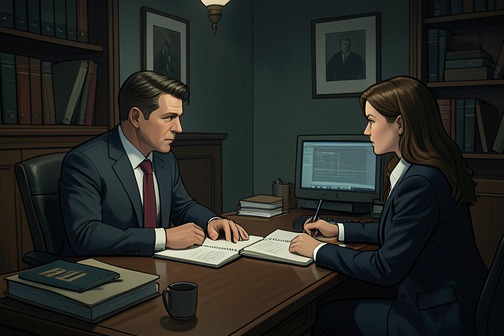
After studying rock history and repeatedly reading *[Interview with the Vampire](entity:object-recall-object-interview-with-the-vam-7b53a6f85e48)*, Lestat reaches a decision about what to do next. His ambition goes beyond making his band successful: he wants fame that will carry his name and voice to the remotest parts of the world. He presents the undertaking to his young lawyer, [Christine](entity:character-recall-character-christine-0a5574df6664), in her darkened office, insisting that the scale of the project matters more than its cost.
The project is designed as a unified work rather than a collection of separate ventures. Lestat proposes to write a book about his life and to accompany it with rock albums and films released together, keeping the work secret until the moment of public revelation. The videos are to be sequential and to tell the book's story, while the music includes songs he has already written. The book supplies the narrative; the recordings and films carry that narrative outward.
## Building the Project
Lestat gives Christine practical instructions for turning the idea into a production. He asks her to recruit leading French directors from New York and Los Angeles, locate studios, and hire the best young record producers to mix the sound. He also specifies the need for superior equipment, including synthesizers, sound systems, electric guitars, and violins. Costume design, how to present the work to rock television stations, and the arrangements for a first public appearance in [San Francisco](entity:location-recall-location-d0db84fe8c04) are left for later; at this stage he wants the necessary calls and information gathered.
Christine initially advises him against risking his fortune. As Lestat presses the plan with confidence, however, her attention shifts toward its prospects for wealth and power, and she begins taking notes. The undertaking moves from conversation to organization: Lestat waits until agreements are reached and signatures secured, dates fixed, studios rented, and letters of agreement exchanged before returning to Satan’s Night Out.
## The Band and the Public Reveal
With Christine, Lestat meets the young players [Larry](entity:character-recall-character-larry-e4ec2b6e8fcf), [Alex](entity:character-recall-character-alex-ad819204cb8d), and [Tough Cookie](entity:character-recall-character-tough-cookie-cfeae847bd1a), bringing them in a limousine and presenting the project over champagne beneath the Garden District's oaks. The name they celebrate, *The Vampire Lestat*, is to belong both to the band and to the book he intends to write. The shared toast marks the venture's transition from private proposal to a collaborative undertaking, with the musicians joining a plan whose full purpose they do not know.
Lestat considers the danger that publicity could bring to his mortal friends. Once secrecy ends, they will enter the international spotlight beside a vampire star, exposed to possible attention from other immortals. He intends to surround them with bodyguards and other helpers and protect them as well as he can. He reasons that ancient vampires would be unlikely to risk a conspicuous confrontation with a human force, but his protective arrangements do not remove the risk that the project's publicity creates.
## Secrecy, Provocation, and Purpose
The project directly violates a rule Lestat regards as sacred among vampires: mortals must not be told that vampires exist. He reflects on how *Interview with the Vampire* has already broken that boundary. [Louis](entity:character-recall-character-louis-b60a54ea5311), its narrator, has told hundreds of thousands of readers about vampires and disclosed information that could point toward Lestat's resting place in [New Orleans](entity:location-recall-location-new-orleans-ac6617a07d7e), though Lestat is unsure what Louis knew or intended. The planned book and media campaign would take the breach further, making disclosure not a side effect but an instrument.
Lestat wants to break the old rules and draw out Louis and the other immortals he has known and loved, including those he has lost and those sleeping as he once slept. He expects fledglings and ancient vampires alike to recognize him through the videos, records, and book, and to know where to find him: his first live performance is to take place in San Francisco. The project therefore serves as a summons as much as a bid for celebrity. Lestat identifies this confrontation among vampires—not fear that mortals will believe the story—as the real reason for the undertaking, while the possibility of genuine revelation and public disaster adds a further risk to the spectacle.
Event 10
莱斯特在地牢首次尝到鲜血
[Lestat](entity:character-recall-character-lestat-1e494e73e33c)’s first taste of blood in [Magnus](entity:character-recall-character-4069da87874e)’s dungeon is the moment when his new existence becomes impossible to treat as an abstraction. Among the remains of young men apparently brought there before him, he discovers that blood awakens a thirst that overwhelms his revulsion. The experience binds his survival to the fate of Magnus’s earlier victims and makes the transformation’s cost immediate: Lestat is not simply changed, but placed within a pattern of captivity and death that he must try to understand.
## Circumstances
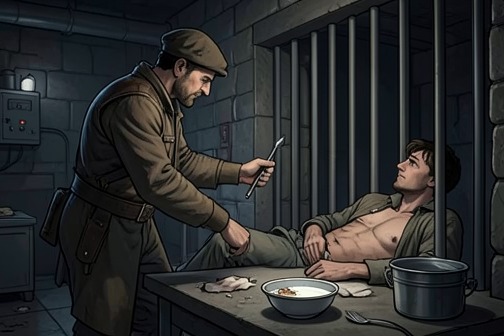
Lestat enters the dungeon beneath Magnus’s tower and finds a prison cell containing the remains of numerous men. Their clothing and boots suggest that they were young, tall, slight, and yellow-haired, like Lestat himself; the most recent corpse is so similar to him that he can imagine it as a brother. Its blue eyes make the resemblance intimate rather than merely general. The discovery leads him to understand that Magnus had brought other young men to the same place, but had condemned them to die rather than granting them immortality.
The cell’s confinement gives this realization its force. The remains, the food and milk left behind, and the dead youth’s position suggest a prisoner who had lived and died there in isolation, aware that death was approaching. Lestat’s horror therefore encompasses both what he sees and the possible fate that had awaited him. He wonders what spared him from the cell’s outcome, but the evidence does not yet provide an answer.
## The First Taste
As Lestat confronts the corpse, pain rises through his ribs and blood comes into his mouth. He sees it on the floor in the torchlight and becomes absorbed by its color and by the way it seems alive amid the dead cell. His attention shifts: thirst displaces nausea, and he bends toward the blood. The change is presented not as a considered decision but as an urgent physical response that takes hold while his thoughts continue to register the prison’s cruelty.
Lestat goes down on his knees and tastes the blood from the stone floor, close to the dead youth. The act brings a tremor of ecstasy, an involuntary reaction that horrifies him because it coexists with his awareness of the victim and of Magnus’s role in bringing him there. He recognizes the contradiction at the heart of the moment: the same scene that fills him with fear and pity also awakens a compelling appetite. His first taste thus reveals what his altered body now demands, before he has learned how to live with that demand.
## Awakening and Aftermath
The first taste ends not in mastery but in alarm. Lestat hears his own guttural scream, drops the torch, and scrambles backward from the blood and the corpse before fleeing up the stairs. He slams the dungeon door, yet the sound continues to rise through the tower and return to him from the stone. The scene leaves the new appetite inseparable from fear: the blood has answered a need he did not know he possessed, but he has not accepted what that answer means.
## Significance
The episode makes the dungeon more than a place of confinement: it reveals a repeated method behind Magnus’s treatment of those he brought there. Lestat recognizes the dead as earlier young men who resemble him, while the blood on the floor marks the difference between their fate and his. That contrast sharpens the scene’s unresolved question—why Lestat was spared the cell’s death—without answering it. His escape ends the immediate encounter, but not its implications: the first taste exposes the appetite accompanying his altered existence, and the victims’ remains make that appetite inseparable from the violence that preceded it.
## Significance
The episode makes the dungeon more than a place of confinement: it reveals the repeated pattern behind Magnus’s treatment of those he brought there. Lestat recognizes the dead as earlier young men who resemble him, while the blood on the floor marks the difference between their fate and his. That contrast sharpens the unresolved question of why Lestat was spared the cell’s death without answering it. His escape ends the immediate encounter, but not its implications: the first taste exposes the appetite accompanying his altered existence, and the victims’ remains make that appetite inseparable from the violence that preceded it.
Event 11
莱斯特秘密探望尼古拉斯并听他演奏
[Lestat](entity:character-recall-character-lestat-1e494e73e33c)’s secret visit to Nicolas on the Île Saint-[Louis](entity:character-recall-character-louis-b60a54ea5311) becomes a wordless reunion in which recognition passes between them through supernatural presence and violin music. Seeing Nicolas living amid the comforts Lestat provided, then hearing a performance that turns despair into beauty, forces Lestat to confront the distance between their beliefs; he leaves with the knowledge that their old conversation is over and with an unspoken resolve to act.
## Background and Approach
In the final decades before the [French Revolution](entity:time-recall-time-7fe2af46abc5), Lestat’s prospects were constrained by his position in a declining aristocratic family. His father was the Marquis, but Lestat was the youngest surviving son, with neither a claim to the title nor a future secured by family wealth. His eldest brother, [Augustin](entity:character-recall-character-augustin-100d7b38f66c), had already spent his wife’s small dowry. Lestat’s life at the family estate in [Auvergne](entity:location-recall-location-auvergne-df7788427a46) had been shaped by deprivation: he hunted game to help feed the household, and there were years when the family might otherwise have starved.
The limits imposed by birth and money continued when Lestat was sent to learn reading and writing. Augustin made clear that the family could not finance a significant career for him in the [Church](entity:organization-recall-organization-church-c786755b8de3); instead, Lestat was expected to accept a narrow life and think of his duties to his nieces and nephews. Lestat wept at supper, calling the household chaos, before his mother came to him. His later choices in [Paris](entity:location-recall-location-657453741ed3) carry the mark of that thwarted future: he had already resisted the role his family and rank prescribed, and the theater had become an alternative world in which he could learn and belong.
The social world around the theater was also marked by class contradiction. Serious drama was reserved to government-sanctioned houses such as the [Comédie-Française](entity:organization-recall-organization-com-die-fran-ais-83f46a9aebc1) and the Théâtre des Italiens, while boulevard theaters grew from fairground spectacles and played to both poor spectators and wealthy audiences. The young bourgeoisie who visited the boulevard theaters, Lestat observed, often aspired to aristocratic status even as some would later help abolish the class they hoped to join. In this mixed, unstable world, Lestat had taken the name Lestat de Valois rather than reveal his family name, de Lioncourt.
## The Visit
As the winter’s sting gave way and Paris’s markets filled with flowers, Lestat suddenly went to [Roget](entity:character-recall-character-1522d55fb028)’s house and demanded Nicolas’s address. He told himself he only wanted to see whether Nicolas was well and whether his home was sufficiently comfortable. The address led to an impressive house on the Île Saint-Louis, its windows shuttered along the quays. Lestat watched it for a long time as carriages crossed the nearby bridge, then climbed the wall with an ease he had never known as a mortal. He crossed the roof and descended into the courtyard, searching for Nicolas’s rooms.
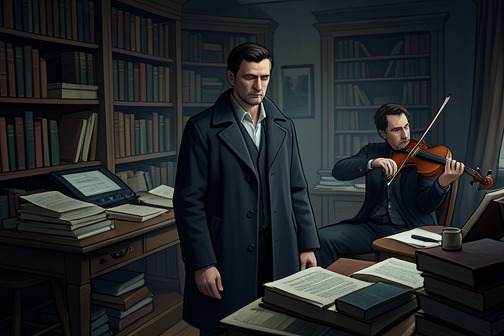
Through an open window, Lestat saw Nicolas at supper with Jeannette and Luchina. They were eating the late meal once shared after the theater closed. Nicolas wore old green velvet, the finery he had worn casually in the crooked streets at home; around him stood visible signs of the wealth Lestat had sent: leather-bound books, an inlaid desk with an oval painting above it, and an Italian violin resting on a new pianoforte. The familiar meal and familiar clothes remained, but the room’s comforts showed how radically Lestat’s money had changed Nicolas’s circumstances.
The glimpse was so overwhelming that Lestat drew back and closed his eyes, gripping the wall to keep from falling. He had seen the room for only an instant, yet fixed every detail in memory. When Jeannette and Luchina took their leave, Nicolas turned toward the window and rose as if called. Lestat understood at once that Nicolas had sensed him. Nicolas’s response was not the confusion of a mortal who sees a face and struggles to recognize it: he had recognized in Lestat’s monstrous presence someone he knew and loved.
## The Violin and Their Unfinished Argument
Lestat fled up the slippery wall to the roof, but he knew Nicolas was moving below. Nicolas lifted the violin from the pianoforte and returned to the window. Lestat covered his ears; the music reached him nonetheless, rising through the night with a force he imagined as more than air, light, or matter. The performance began with long, vibrant notes and chilling glissandos, the violin seeming to speak in a language that made other forms of speech feel false.
As Lestat listened, the music became the essence of despair. Its beauty seemed at first like a cruel coincidence, an irony that could not redeem the anguish from which it emerged. Lestat wondered whether Nicolas was making the violin express his own distrust of goodness: perhaps beauty meant nothing if it came from despair, and perhaps the contrast between them only made beauty seem more treacherous. The question remained unanswered. The music outgrew the despair, settling into a slow melody that Lestat compared to water finding its downward path through the mountains; it grew darker, richer, vast, and heartbreaking. Lestat lay on his back on the roof, looking at the stars.
The performance gave Lestat a kind of silent understanding, though it could not restore their conversation. He concluded that beauty was not the betrayal Nicolas believed it to be. It was an unmapped, indifferent territory in which fatal errors were possible and no signposts marked good or evil. The refined achievements of civilization—the perfection of a string quartet or the grandeur of Fragonard’s canvases—did not tame beauty. It remained savage, older than human codes of conduct: a [Savage Garden](entity:expression-recall-expression-savage-garden-7701bcb784c4).
Lestat also reconsidered what Nicolas had wanted from their former arguments. Nicolas may have dreamed of harmony among all things, an ideal Lestat had always considered impossible; more specifically, Lestat thought Nicolas had dreamed not of goodness but of justice. That difference helps explain why the violin’s beauty could not settle their dispute. The music offered a profound form of communication, but it did not erase their incompatible hopes or reopen the life they had shared at the inn.
## Departure and Consequence
Lestat remained on the roof, listening, but did not go to Nicolas or make himself known. He recognized that they could never again resume their old life or continue their conversation. His farewell was inward and belated: he asked Nicolas’s forgiveness, acknowledged that good and evil still existed, and accepted that their exchange was over forever. The scene thus brings recognition without reunion. Nicolas senses the person he loved beneath the monstrous presence, while Lestat receives the recognition but cannot answer it openly.
As he slipped silently away from the Île Saint-Louis, Lestat knew what he intended to do, although he would not admit the intention to himself. The next night, already late, he reached the boulevard du Temple after feeding on the Île de la Cité; the first act was under way at [Renaud’s House of Thesbians](entity:organization-recall-organization-renaud-s-house-o-fd931cf5ca39). The narrative places this return to the theater immediately after the roof scene, connecting the encounter’s private emotional force to an action Lestat has not yet confessed, rather than presenting reconciliation as its outcome.
The visit also gives new meaning to the artistic world that had once held Lestat and Nicolas together. In the theater, Lestat had lived for hours among quarrels, laughter, and shared labor, learning the stage while Nicolas’s violin solo brought the performance to a close. At Nicolas’s shuttered-window home, music again becomes their closest available speech, but now it carries the very disagreement that their former companionship could not resolve. The scene’s decisive change is not that their bond disappears: Nicolas’s recognition and Lestat’s response confirm its continuing force. It is that love and artistic understanding no longer provide a shared life or a path back to conversation.
Event 12
莱斯特在雷诺剧院公开展示吸血鬼力量
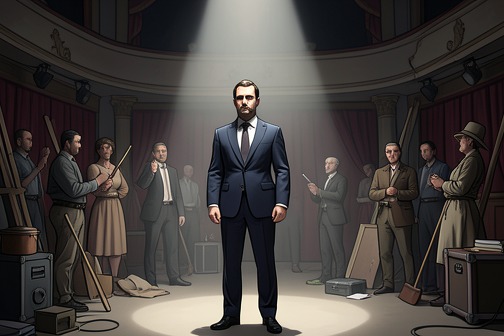
[Lestat](entity:character-recall-character-lestat-1e494e73e33c)’s public display of vampire power at [Renaud](entity:character-recall-character-6a83719fd50c)’s theater begins as a return to the human community he had left and becomes an uncontrolled revelation of what he has become. In the familiar playhouse, affection for Nicolas and the players briefly seems to revive his old life; then hunger, extraordinary physical abilities, and a voice that overwhelms the audience turn the stage into evidence of his changed nature.
## Return to the Theater
Late one night, after feeding in the Île de la Cité, Lestat arrived at [Renaud’s House of Thesbians](entity:organization-recall-organization-renaud-s-house-o-fd931cf5ca39) while the first act was already in progress. He had dressed formally and came by hired carriage, but the theater’s backstage world—the performers, props, and familiar bustle—made the visit less a social entrance than a confrontation with his former life. The actors greeted him with astonishment and excitement. Luchina called for Nicolas, while Renaud presented Lestat as the owner of the theatrical establishment.
The reunion brought Lestat close to the people whose company had once shaped him. He held Luchina and Jeannette, resisted looking directly at the lights, and worried that his tears might expose him. When Nicolas came to him, the embrace briefly displaced the horrors and changes that had separated Lestat from his former self. The moment’s intimacy, however, did not restore the relationship to its earlier terms: Lestat could hear and smell the blood in Nicolas, and realized that he wanted it. His love remained real, but it now existed alongside the predatory hunger of a vampire.
## The Stage Becomes a Test
Before Lestat had decided to perform, he found himself in the center of the stage. He ordered an acrobat away and began imitating the movements he had learned from performers at village fairs: turns, cartwheels, and somersaults. His agility surpassed the limits of ordinary human performance. He sang the little ditty associated with his former role as Lelio, joining a remnant of his acting past to a display of abilities he could no longer pass off as merely theatrical.
The audience first responded with applause. Lestat then directed his voice at the packed house, steadily singing louder until the music overwhelmed the spectators. People stood, screamed, overturned benches, and struggled toward the exits; some dropped from the gallery in their rush to escape. The performance had shifted from entertainment to a demonstration of power. Its effect depended on the theater’s ordinary equipment—stage, footlights, audience, and song—but those familiar means could no longer contain what Lestat was showing.
## Gunshot and Revelation
An older man in a private box confronted Lestat with a pistol. Nicolas shouted a warning, but the shot struck Lestat without stopping him. The man dropped the weapon and collapsed. Lestat, by contrast, found that the wound had disappeared: although blood remained on his clothes and he felt the aftereffects of the impact, his body had healed. Nicolas initially thought he was witnessing Lestat’s death, then recognized that Lestat was unharmed despite what reason would suggest.
The contrast made the scene’s disclosure unmistakable. Lestat’s voice and acrobatics might have been interpreted as extraordinary acting, but surviving a bullet and recovering from the wound exposed a physical difference that performance could not explain away. The episode thus made the theater a public testing ground for Lestat’s supernatural abilities, with Nicolas among those forced to confront their reality.
## Consequences and Significance
The encounter joins two forms of exposure. Lestat’s return places him among people he still loves, especially Nicolas, but the closeness of that reunion also intensifies his hunger and makes ordinary affection newly dangerous. Onstage, he turns his former craft into an outlet for powers he has not mastered; the resulting panic and the gunman’s failed attack reveal that the old theatrical world cannot shield its members from his changed nature.
The episode also stands in tension with the secrecy vampires regard as sacred. Lestat had already wondered whether other vampires would notice that [Louis](entity:character-recall-character-louis-b60a54ea5311)’s published account had told mortals about their kind and disclosed information about Lestat’s resting place. At Renaud’s theater, the danger is no longer only what a book might tell its readers: Lestat himself makes his difference visible before a human audience. His flight from the theater follows the discovery that a presence in the crowd is keeping pace with him—and that there is more than one such presence—so the public display also leads into a new, immediate threat.
Event 13
莱斯特在圣母院杀死乞讨的母亲与孩子
The killing of a beggar woman and her child in Notre-Dame is the decisive breach in [Lestat](entity:character-recall-character-lestat-1e494e73e33c)’s restraint: after waiting through the night in the cathedral, he preys on the pair who approach him, then leaves convinced that innocence offers no protection from his hunger. He recasts the deaths as confirmation of his [Savage Garden](entity:expression-recall-expression-savage-garden-7701bcb784c4), a vision in which aesthetic principles—not human morality—give the world its meaning.
## Background and Setting
The episode follows Lestat’s violent encounter with a group of vampires who pursue him after he turns away from them. He does not lose their strange, toneless shimmer until he reaches the Place de Grève and enters Notre-Dame. There he spends the rest of the night concealed in shadow, weakened by the blood he has lost and aware of his hunger as mortals come near. The cathedral becomes the setting for a choice he has delayed: rather than feed immediately, he waits until he believes the moment has come.
The city’s social divisions form part of the wider context of his life, though not a direct cause of this encounter. Lestat was born the youngest surviving son of a financially depleted noble family in the [Auvergne](entity:location-recall-location-auvergne-df7788427a46), without a claim to its title or land. In [Paris](entity:location-recall-location-657453741ed3) he has instead made his life in the boulevard theater, whose performances serve audiences excluded from the official houses of serious drama. The contrast between an aristocratic birth, public entertainment, and the poverty of the people he encounters sharpens the social range of the episode without excusing his actions.
## The Encounter in the Cathedral
A young beggar woman approaches with her small child. Seeing the dried blood on Lestat, she becomes alarmed and tries to help him by taking him to the nearby Hôtel-Dieu hospital. Her attempt at care is the immediate circumstance of the killing: Lestat responds not by accepting assistance but by feeding on the woman and then the child. He chooses both as victims, and the child does not understand what is happening.
Afterward, Lestat looks at the pair, dead together, and recognizes that the cathedral has offered them no sanctuary. The scene overturns the expected meaning of its setting: a place associated with refuge does not protect the vulnerable, while the apparent offer of human compassion becomes the occasion for predation. The woman’s effort to help him makes the reversal especially stark; her kindness neither changes his decision nor saves her child.
## The Savage Garden and Its Consequence
Lestat understands the episode as proof that his vision of the Savage Garden was true. In that vision, the world has meaning and laws, but he believes they belong only to the aesthetic. He treats beauty as the sole dependable principle and interprets the victims’ innocence as intensifying the significance of the feeding rather than as a reason to spare them. His conclusion is not that he has failed to uphold a moral rule, but that moral rules do not govern the world he inhabits.
That interpretation supplies the event with its lasting consequence. Lestat leaves Notre-Dame in the early morning believing that the last barrier between his appetite and the world has dissolved. He explicitly extends the danger beyond strangers: his friends at [Renaud](entity:character-recall-character-6a83719fd50c)’s theater and his beloved Nicki are no longer exempt. The attack therefore changes the terms of his relationships as well as his conduct. What had been a boundary on whom he might harm has become, in his own understanding, no boundary at all.
## Narrative Significance
The episode joins an intimate act of violence to a sweeping claim about how the world works. Lestat turns a particular encounter—with a woman who seeks help for him and a child beside her—into evidence for an aesthetic doctrine that erases the ethical distinction between innocence and guilt. The doctrine makes the event legible to him, but it also exposes the price of his chosen interpretation: beauty becomes a justification for refusing the obligations that the victims’ vulnerability might otherwise impose.
The cathedral’s failed promise of shelter and Lestat’s dawn departure mark a threshold in his story. He does not leave with uncertainty about whether his hunger can reach the innocent; he leaves convinced that it can and will. The event’s significance lies both in the deaths themselves and in the reasoning Lestat builds around them, which prepares the possibility of violence against those he loves.
Event 14
莱斯特将加布里埃尔转化为吸血鬼
[Lestat](entity:character-recall-character-lestat-1e494e73e33c)’s transformation of [Gabrielle](entity:character-recall-character-f84321db0300) is both an act of rescue and a rupture in their relationship: faced with his mother’s imminent death, he offers her the dangerous immortality he has only recently come to understand. Gabrielle accepts, and the two awaken to a future together in [Paris](entity:location-recall-location-657453741ed3). The turning converts a private bond shaped by dependence, conflict, and separation into a new companionship between immortals.
## Background and Immediate Crisis
Gabrielle’s turning takes place when Lestat is with her in Paris and she is dying. He recognizes the change in himself as he looks toward her bedroom: he cannot move or speak, and the familiar surroundings become indistinct against the fact of her decline. The candle he had ordered to be left burning is nearly spent; the doctor and nurse are present, and he can hear Gabrielle’s thoughts. His supernatural awareness makes the crisis intimate, but it does not make its outcome less immediate.
The choice that follows is not described as a prepared scheme. Lestat experiences a sudden, overwhelming shift and understands that he has decided, before he could have explained or admitted the decision to anyone. That unspoken resolve matters: he does not begin by presenting a plan for Gabrielle’s future. Instead, he reaches a point at which allowing her to die and offering her transformation have become inseparable possibilities.
## Disclosure and Consent
Before turning Gabrielle, Lestat tells her what has happened to him. He recounts the figure that attacked him at the theater, the tower and exchange of blood, the crypt where he sleeps, his powers, and the nature of his thirst. He explains that blood intensifies desire and that feeding can end in death. His account does not soften the peril or claim certainty about what he can give her; it lays out the life she would be entering as far as he understands it.
As Gabrielle’s illness worsens, Lestat makes the offer without concealing his ignorance or fear. He wonders whether he can give the [Dark Gift](entity:concept-recall-concept-dark-gift-8ccbb9152cb6) more than once and what the price might be, but he is willing to risk the attempt with her. Gabrielle answers with a whole-hearted yes, then repeats her consent aloud. Her agreement distinguishes the decision from an act imposed on her: the choice is made under the pressure of imminent death, but Lestat has disclosed the essential nature of the transformation, and Gabrielle affirmatively accepts it.
## The Turning
Lestat begins the exchange by drinking from Gabrielle, then offers his own blood to her from his wrist. The movement makes the transformation reciprocal in a strikingly literal sense: he has taken blood from her and now gives his blood in return. Gabrielle drinks, grows stronger, and holds him upright as the exchange continues. Lestat, weakened by her taking his blood, eventually forces her away; she stands before the window while he collapses into a chair.
The scene also alters how Lestat sees her. During the act, his memories of Gabrielle as mother, companion, and source of both need and conflict converge with his vampire thirst. Yet the transformation does not leave her reduced to those roles: in the moment of change, he recognizes her as Gabrielle in her own right. The scene carries the history of their relationship into the new bond rather than erasing it.
## Awakening and Significance
When Lestat comes to himself, the setting confirms that the change has succeeded: he is in Paris, and Gabrielle is alive beside him. She lights the candles in the room, moving with renewed vitality. Her face appears smooth and free of the marks of illness that had defined her dying condition. The immediate outcome is not simply her survival, but their shared entry into immortal life.
This turning reverses the solitude of Lestat’s own transformation. He had learned the nature of vampirism through an abduction and an experience he could not control; with Gabrielle, he reveals what he knows, acknowledges what remains uncertain, and makes the choice together with her. The act cannot promise an ordinary recovery: it brings Gabrielle into the same thirst and supernatural existence that Lestat has described. Its decisive consequence is that the mother he feared losing becomes his companion in an existence they will face together.
The event also reframes Lestat’s relationship to secrecy. He understands that vampires regard disclosure to mortals as a grave breach, yet at this crisis he tells Gabrielle about his powers, lair, and thirst so she can decide whether to join him. His disclosure is not an account for a public audience; it is the condition of an intimate, consequential choice. In saving Gabrielle from imminent death, he crosses the boundary between protecting her as a mortal and inviting her into the hidden world that has remade him.
Event 15
吸血鬼袭击莱斯特的塔楼
The vampire attack on [Lestat](entity:character-recall-character-lestat-1e494e73e33c)’s tower is the point at which a persistent, unseen menace becomes an organized assault on [Lestat and Gabrielle](entity:relation-recall-relation-lestat-and-gabrielle-fdeaba11ef28). The attackers are not only a physical danger: they are vampires who regard their victims as religious outlaws, and their retreat leaves a mortal boy dead. The encounter exposes the violence beneath their claims of faith and sets Lestat and Gabrielle against a group whose doctrine makes the attack seem righteous to its members.
## The Stalking Presence
By the time Lestat and Gabrielle reached the livery stables, they understood that the presence had been following them. Its low hum came and went, sometimes remaining absent for half an hour or longer; attempts to read coherent thoughts from it yielded only malice and confused impressions. The uncertainty made the threat difficult to locate or anticipate.
The danger became more immediate on the familiar ride to the glade. Lestat’s mare balked at the route, while [Gabrielle](entity:character-recall-character-f84321db0300) watched the dark copse concealing the stream. There, the presence seemed to gather in the trees, and she recognized that it was growing stronger and was not solitary. The discovery overturned Lestat’s expectation that the thing would simply flee again: this time, the unseen pursuers were waiting in numbers.
## Assault at the Bridge
Lestat urged the mare across the narrow wooden bridge, with Gabrielle beneath his arm and his weapon ready. On the far side, white faces and arms appeared among the branches, accompanied by shrieks and falling leaves. One assailant reached Lestat, while another sprang at them; Lestat struck at the first, and Gabrielle cut the outstretched arm of the second. Rather than remain to fight in the copse, they drove the horse toward the tower as the pack pursued them.
When the exhausted mare could go no farther, Lestat and Gabrielle abandoned her and ran hand in hand to the gates. They took refuge in a small church cell and prepared firewood beneath its window. A half-dozen pale faces appeared at the bars. Their ragged clothing and threatening cries had made them look monstrous, but Lestat recognized them as vampires, like himself and Gabrielle, in human form. Their apparent weakness did not make the barred opening safe: they clung to the grating, reached for Gabrielle, and tried to force their way inside.
## Fire and the Attackers’ Creed
Lestat thrust a stout piece of wood through the grating to drive back the nearest attackers while Gabrielle lit the kindling. When the flames rose, the vampires stopped howling and shouted warnings to one another about the fire and heated bars. Their response made the practical reversal plain: the fugitives had found a way to hold off their pursuers, and the attackers began scrambling down from the window.
As they retreated, their cries took on the language of religious condemnation. They denounced Lestat and Gabrielle as profaners and outlaws for entering the House of God. That accusation reveals the attackers’ creed: they understand their own existence through a strict opposition between the dead and the sacred, and condemn other vampires who cross the boundary their doctrine sets. In the later account of the [Rules of Darkness](entity:rule-recall-rule-rules-of-darkness-0808564fe307), vampires are instructed to dwell among the dead, shun places of light, honor God’s power and sacraments, and never enter a church. The assault thus brings a code of belief into direct conflict with Lestat and Gabrielle’s choices; the church, where the attackers expect to condemn them, also becomes the place from which fire forces the pack back.
## Retreat and Mortal Cost
The fire caught in the heavy timbers, filling the cell with heat and leaving Lestat and Gabrielle exhausted, but they were not physically harmed. As they listened, Gabrielle realized the pack had failed to break down the gate and was drawing away. Their immediate escape from the attackers did not mean that the danger had passed.
Near the stables, the vampires killed the mortal stable boy. Lestat perceived the murder through the images the attackers sent into his thoughts; Gabrielle listened and understood that the boy was dead. When they later reached the stable, they found his body and discovered that the horses were gone. The contrast is central to the episode’s outcome: the fire has driven the pack off, but it has not protected a vulnerable human caught in the attackers’ path. Lestat’s response is a promise that they will pay, while Gabrielle’s attention remains fixed on the boy, drawing her into the gravity of what has happened.
## From Threat to Conflict
The assault changes the presence from a recurring, hard-to-interpret disturbance into a recognizable enemy. First there is only an intermittent hum and malice; then a gathering in the copse, a coordinated pursuit, and a siege at the church window. The sequence narrows the distance between suspicion and confrontation, while the killing at the stable gives the encounter consequences beyond Lestat and Gabrielle’s survival.
The attackers’ religious language also establishes that their hostility is not merely a territorial clash. They identify themselves as servants of Satan and treat the old prohibitions as binding rules for vampires, while Lestat and Gabrielle have crossed into a church and survived through fire. The attack therefore stages a conflict between rival understandings of what vampires are and how they should live. Its immediate ending is an escape from the cell and a discovery of the boy’s death, not a resolution with the pack; Lestat’s vow of retaliation points toward conflict still to come.
Event 16
莱斯特与加布里埃尔躲入教堂墓穴并冲出祭坛
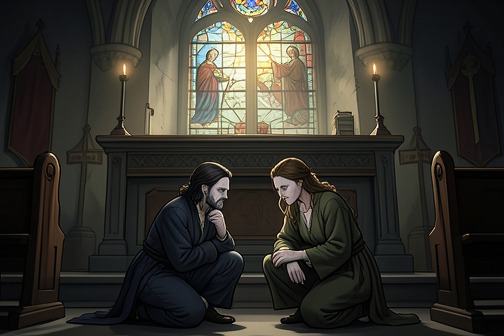
[Lestat and Gabrielle](entity:relation-recall-relation-lestat-and-gabrielle-fdeaba11ef28)’s retreat into a church crypt and their escape through the congregation is a reversal in which sacred space offers temporary shelter but becomes a trap. Forced to flee as daylight threatens [Gabrielle](entity:character-recall-character-f84321db0300), they hide beneath the church floor and later use the congregation’s fear to break out.
## Flight into the [Church](entity:organization-recall-organization-church-c786755b8de3)
After the pair leave the village churchyard, [Lestat](entity:character-recall-character-lestat-1e494e73e33c) half-carries Gabrielle to a side door and quietly breaks its latch. She says that she is cold and that her eyes are burning, and asks for somewhere dark. At first, Lestat tries to bring her inside. Gabrielle objects that God is not in the House of God, but Lestat pulls her through the sacristy and out before the altar.
The building does not protect Gabrielle from the approaching daylight. She looks toward the crucifix above the tabernacle, then shields her eyes from the stained-glass windows: although Lestat cannot yet feel the rising sun, its light is already burning her. The scene overturns the apparent safety of the church. Its religious images do not stop the danger; the light entering through its windows makes darkness immediately necessary.
## A Tomb Beneath the Altar
Lestat carries Gabrielle to the Blessed Virgin’s altar, where worn inscriptions mark an old burial place. He hooks his fingernails around a stone slab, lifts it, and finds a deep sepulcher containing a single rotted coffin. He lowers Gabrielle into the vault and replaces the slab. The shelter is a grave beneath the church, not a room in which the pair can freely move or wait out the day.
In the darkness, the coffin breaks beneath them. Lestat realizes that hundreds of people are above them, singing a hymn; the church is full, and the two vampires cannot leave the nest of bones until the congregation has gone. Their hiding place thus becomes an enclosure within a living religious ceremony. Gabrielle recognizes that the singing is part of Benediction and warns Lestat that the Blessed Sacrament is on the altar. Her awareness of the rite turns their predicament from a problem of confinement into a crisis of religious terror.
## The Escape from the Vault
As the service continues, Gabrielle struggles to remain still. Lestat can no longer hold her back and decides that they must get out before the congregation discovers them. He proposes that they emerge as vampires and frighten the people into retreating, rather than risk being seized and taken to prison. His plan depends on the crowd’s reaction: terror will make an opening where the blocked exit and occupied church offer none.
Lestat shoves up the marble slab and springs from the vault, raising his cloak in a broad arc and crying out. Hundreds of people rise and scream. Gabrielle follows his lead, raising a clawed hand and wailing as Lestat takes her by the hand and drives them down the aisle. People clutch at children, shriek, and fall back; in the panic, the pair reach the heavy doors and escape into the night. Lestat scatters gold coins across the marble floor as he turns back toward the congregation, further disrupting the pursuit.
## Reversal and Significance
The episode reverses the meanings of both church and tomb. The church first supplies a hiding place from the sun, but its congregation prevents a quiet exit; the burial vault protects the pair while also confining them beneath the ceremony. Lestat escapes by making the danger visible on his own terms, converting the churchgoers’ fear of vampires into a means of survival.
The sequence also links the practical limits of vampiric life to religious space. Gabrielle’s exposure to daylight compels them into the crypt, while the ongoing Benediction makes that refuge intolerable to her. Their escape does not resolve the conflict between vampire existence and the sacred setting; it is a fast, improvised passage out of the church, achieved by exploiting the very fear that has trapped them there.
Event 17
圣殇墓园的审判与旧盟约瓦解
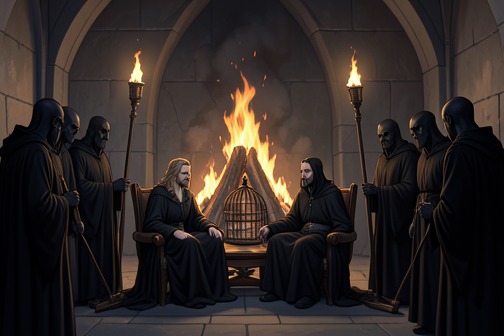
The confrontation known as the Trial of [Lestat](entity:character-recall-character-lestat-1e494e73e33c) and the breaking of the old covenant turns the coven’s attempt to judge [Lestat and Gabrielle](entity:relation-recall-relation-lestat-and-gabrielle-fdeaba11ef28) into a crisis of authority. In a dim, domed chamber, the vampires invoke their rules and threaten punishment; Lestat answers by challenging the beliefs that sustain their power, then frees Nicolas from a cage above a pyre. [Armand](entity:character-recall-character-a8d393c13b59)’s declaration that it is over dissolves the gathering’s authority and marks the old covenant’s failure.
## Setting and Stakes
The trial takes place in a great domed chamber, lit by three torches arranged in a triangle around Lestat and Gabrielle. Its central space becomes a stage for judgment: the coven gathers around the pair, while a black-draped pyre and the captive Nicolas reveal that the proceedings threaten more than a formal reprimand. Nicolas is slumped inside a crude wooden cage atop the pyre, and his apparent inability to recognize Lestat makes the danger immediate.
The coven’s accusation is grounded in its inherited rules. A young vampire denounces Lestat as the creation of the outcast [Magnus](entity:character-recall-character-4069da87874e), who made him in defiance of the coven and the [Dark Ways](entity:concept-recall-concept-dark-ways-ef419c052f81); he further charges that Lestat rashly gave [Gabrielle](entity:character-recall-character-f84321db0300) the [Dark Gift](entity:concept-recall-concept-dark-gift-8ccbb9152cb6). A woman in the group declares that the coven’s leader is Satan and that its members serve him. Their claim to punish Lestat and Gabrielle thus depends on a religious order that treats departure from its rules as a violation of cosmic authority.
## The Coven’s Doctrine
Armand explains the history and logic of the [Rules of Darkness](entity:rule-recall-rule-rules-of-darkness-0808564fe307). The vampires who emerged from the old chambers were, in his account, tested and purified, made into [Children of Darkness](entity:organization-recall-organization-3e34de68765e) through a fledgling’s blood rather than the full power of an ancient master. Their rules prescribe life among the dead, return to a grave or a place like one, avoidance of the light, and the isolation of victims from the company of others. They are also commanded to honor the power of God and the sacraments, while never entering a church lest divine force destroy them.
This doctrine makes the coven’s authority depend on a paradox: the vampires who call themselves servants of evil also insist on reverence for the power of God. Armand treats the inherited prohibitions as mysteries that must be preserved, and he identifies Magnus’s contempt for them as a form of madness. His explanation exposes the rules not only as practical restrictions but also as the basis of the group’s identity and its power to judge.
## Lestat’s Challenge and Nicolas’s Release
Lestat rejects the theology behind the coven’s threat. He argues that its members have built their philosophy on a lie and chosen to live as though already condemned; he contrasts their self-imposed submission with his and Gabrielle’s refusal to accept the same terms. Rather than acknowledge the coven’s judgment, he makes its members confront the gap between their professed beliefs and the fear with which they enforce them. The gathered vampires turn their attention toward Armand, but their leader initially says nothing.
During the resulting confusion, Lestat climbs onto the pyre and tears open the front of Nicolas’s wooden cage. He brings Nicolas down to the floor, where Nicolas remains feverish and pushes him away, cursing under his breath. Lestat places a pearl rosary around Nicolas’s neck, with its crucifix visible. Nicolas looks down at the cross and laughs; in the scene, the gesture and reaction sharply distinguish him as the mortal among the vampires. Gabrielle remains composed and cautions Lestat through the pressure of her hand, while [the old queen](entity:character-recall-character-4e5030e7aff3) watches with fascination.
## Armand’s Decision and the Covenant’s End
The turning point comes when the gathered vampires look to Armand. In the silence, he says, “It is finished.” He then orders them to go, declaring that it is at an end. A young vampire protests, addressing him by name, but the others begin to withdraw. Their response makes the decision more than a private concession: the group that had assembled to judge Lestat and Gabrielle disperses, and its instruments of ceremony are put aside.
The confrontation therefore ends not with the coven’s punishment of its challengers but with the collapse of its claim to govern them. Lestat’s challenge has made the old rules appear contingent rather than unquestionable, while the release of Nicolas overturns the immediate spectacle of judgment. Armand’s words acknowledge the break without restoring the authority that preceded it; the gathering disperses, leaving the old covenant at an end.
Event 18
阿曼德焚毁巴黎旧盟会
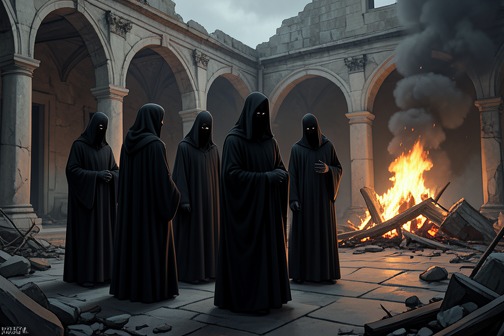
[Armand](entity:character-recall-character-a8d393c13b59)’s destruction of the [Paris coven](entity:organization-recall-organization-679e37879574) is the violent end of an old vampire community and the point at which its survivors appeal to [Lestat de Lioncourt](entity:character-recall-character-lestat-de-lioncourt-0acd1217f0bb) to help them begin again. The attack is not simply a contest for control: it destroys members, sacred resting places, and the inherited faith that had governed the coven, while [the old queen](entity:character-recall-character-4e5030e7aff3)’s death takes with it the knowledge she had preserved.
## The Covен and Its Inherited Order
The group Armand destroys belongs to an older Parisian vampire world organized around the [Dark Ways](entity:concept-recall-concept-dark-ways-ef419c052f81): a faith and discipline meant to keep vampires hidden from mortals. The survivors later explain that their master could claim the right to destroy those too weak to survive, and that adherence to the old ways was supposed to prevent the coven from alarming the mortal population. Its rules therefore joined religious authority to practical survival. The graves were more than burial places; they were the community’s prescribed refuge and a visible expression of its shared order.
The coven’s end unfolds against the pressures of a changing society. In the late eighteenth century, the boulevard theaters where [Lestat](entity:character-recall-character-lestat-1e494e73e33c) had worked occupied a marginal but thriving place beside the government-sanctioned [Comédie-Française](entity:organization-recall-organization-com-die-fran-ais-83f46a9aebc1) and Théâtre des Italiens, which held the rights to serious drama. The theater world also brought aristocrats and wealthy bourgeois spectators together, even as the bourgeoisie pursued aristocratic titles and joined families whose class system would soon be swept away by revolution. This social instability is a human parallel, not the cause of Armand’s attack: the vampire community faces its own upheaval as the old authority and belief in the Dark Ways fail.
## The Destruction and the Survivors
By the time the survivors reach Lestat, they describe a catastrophe already in motion. Armand has driven his followers toward a pyre, using a great charred beam to force them into the blaze and thrusting them back into the flames when they struggle to escape. The report comes to Lestat through the survivors’ minds as well as their speech: he catches images of the fire and of Armand wielding the beam. The violence is thus conveyed as a shared, intrusive memory, not merely as a detached account of a past event.
The woman who asks Lestat for help says the coven once numbered twelve. Six were burned together; the others fled in terror and spent the day in unfamiliar resting places, outside their sacred graves for the first time. When they rose, Armand found them again and destroyed two more. The remaining members also say he broke open the deep chambers and burned the starving vampires concealed there. He then loosened the earth to block the tunnels leading to the coven’s meeting place. The attack reaches beyond its immediate victims: it removes the living from their refuge, destroys those too weakened to flee, and physically obstructs the routes by which the community gathered.
## The Old Queen’s Death and the Request for Help
The survivors’ account distinguishes the old queen’s death from Armand’s killings. The boy among them tells Lestat bitterly that she threw herself into the fire, laughing and saying she would go to join [Magnus](entity:character-recall-character-4069da87874e). Her suicide came just before Armand drove the others into the flames as the rest fled. Lestat bows his head when he learns she is gone. In his judgment, her death means more than the loss of one member: with her, all that she had known and witnessed has disappeared. What remains, in his bleak assessment, is the simple one, the vengeful one, and the wicked child who believes that what the old queen knew was false.
A dark-eyed survivor urges Lestat to form a new coven with those left alive, so they can exist as he does. She frames Armand’s violence as an assertion of his right as coven master to destroy the weak; another vampire argues that without faith in the Dark Ways the others might have blundered and exposed themselves to mortals. Their appeal is therefore practical and ideological at once. They ask for a community capable of surviving, but also for a replacement order after the old one has been shattered. Lestat’s question about the old queen shows that he recognizes what their proposed renewal cannot restore: the witness and accumulated memory she carried.
## Significance and Narrative Frame
The event is narrated retrospectively by Lestat, who encounters the survivors after the destruction and reconstructs it from their testimony and mental images. That frame makes the scene a revelation of consequences rather than a direct depiction of every stage of the assault. The figures before him—the dazed boy and the vampires disguised in rags—bring the aftermath into view, while their appeal places Lestat in the position of a possible founder of a new community.
The destruction also exposes a contradiction within the coven’s old order. Its leaders invoked discipline and secrecy to protect vampires from the mortal world, yet the same structure authorized a master to eliminate those deemed weak. Once its sacred graves, deep chambers, and meeting tunnels are violated, the practices that had sustained the group cannot simply resume; the surviving members must seek a new way of existing. The coven’s fall is therefore both a massacre and a break in transmission: its people may survive, but the authority, refuge, and inherited knowledge that made them a community have been devastated.
Event 19
尼古拉接受黑暗之礼
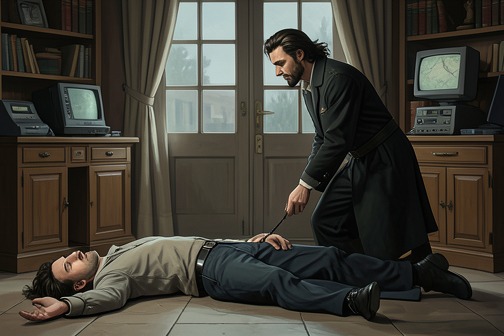
Nicolas’s transformation marks the point at which [Lestat](entity:character-recall-character-lestat-1e494e73e33c)’s longing to keep his beloved close becomes an act that separates them. Lestat offers Nicolas the [Dark Gift](entity:concept-recall-concept-dark-gift-8ccbb9152cb6), and Nicolas accepts by drinking from Lestat’s throat; when the change is complete, he is silent and unresponsive. The scene turns a hoped-for reunion into a rupture, while exposing the difference between immortality as a promise and the life it actually brings.
## Background and Stakes
The transformation takes place against a body of rules and memories that make the Dark Gift more than a private exchange. Lestat knows that vampires are bound by a secrecy law: they do not reveal their existence, other immortals, or the locations of their lairs to mortals, except when intending to pass on their powers. That law helps explain why the gift is consequential: it does not merely extend a human life but draws its recipient into a concealed immortal world.
Lestat has also heard a severe account of how the old vampires understood their own initiation. In that account, candidates first proved themselves through crimes, appeared to die before their loved ones, and received only a small infusion of vampire blood. They then endured burial and thirst until they could break out of their coffins. The [Rules of Darkness](entity:rule-recall-rule-rules-of-darkness-0808564fe307) were built around that passage: the newly made were to live among the dead, return to graves, avoid the light, and follow strict religious prohibitions. This inherited framework contrasts with Lestat’s deeply personal offer to Nicolas, for whom the transformation is bound up with their shared past and Lestat’s desire for their companionship.
## The Invitation and Acceptance
As Lestat approaches Nicolas, he recognizes that the circumstances give him the excuse he had wanted: to bring Nicolas to him and offer him eternity. Yet desire does not settle the moral question. Lestat’s thoughts hold both the promise of shared pleasure and the possibility of taking Nicolas’s life, and the scene makes his decision an immediate, consequential choice rather than an abstract wish.
Lestat unlocks the room and tries to see Nicolas as the mortal before him, distinct from Lestat’s longing and thirst. He beckons Nicolas to come to him and tells him that he must come if he wants the gift. The invitation leaves acceptance with Nicolas, but it is made within an unequal and emotionally charged encounter: Lestat holds the power to transform him, while Nicolas faces a choice whose consequences cannot yet be known.
Nicolas responds by reaching around Lestat and drinking from the wound Lestat has made in his own throat. That act is the decisive threshold of the event. The transformation is not described as a return to their former human life; it is an entry into a new condition, one Lestat has wanted for them both but cannot control in its effects.
## Separation and Immediate Aftermath
As the change finishes, Nicolas becomes separate from Lestat. He draws away, blood at his mouth, and emits a dry scream; the silence that follows recalls the silence that came over [Gabrielle](entity:character-recall-character-f84321db0300) after her own transformation. The parallel makes the outcome legible to Lestat even before he can understand what Nicolas’s new condition will mean: the gift has crossed a boundary, but it has not preserved the intimacy that preceded it.
Gabrielle appears in the doorway and calls the outcome a disaster. By midnight, Nicolas will not speak or answer anyone, and he does not move of his own accord. He remains still and expressionless wherever he is taken. The narration leaves his inner experience uncertain: it cannot establish whether the death of his former life pains him or whether his new vision delights him. It does establish that even thirst does not move him.
Gabrielle, rather than Lestat, takes practical care of him. After watching him quietly for hours, she cleans him and puts him in black wool and modest linen, clothes that make him look unusually like a young cleric. The attention gives Nicolas a place in the household, but it cannot undo his withdrawal. The transformation thus ends its immediate sequence not in renewed conversation or reunion, but in care for someone who no longer answers.
## Meaning and Consequences
The event reverses the promise that has driven Lestat toward Nicolas. Lestat imagines eternity as a way to recover their closeness, yet the first consequence is a silence that puts Nicolas beyond ordinary response. Immortality is granted, but the human future they once shared—talking together, walking through [Paris](entity:location-recall-location-657453741ed3), growing older—cannot simply be carried across the threshold. The scene’s remembered image of an empty world gives form to that loss without resolving what Nicolas himself experiences.
The transformation also complicates the older initiation rules. The history Lestat has heard describes a communal and punitive ordeal, governed by prohibitions and the fear of failing to escape the grave. His offer to Nicolas is instead personal, driven by love, desire, and the hope of shared eternity. Yet the different circumstances do not guarantee a gentler result: Nicolas’s acceptance leads at once to an altered state that Lestat cannot interpret or reverse.
In the larger account, Nicolas’s transformation is therefore both an act of attachment and the beginning of estrangement. Lestat chooses to extend Nicolas’s existence, but the immediate change deprives him of the responsive companion he hoped to keep. Gabrielle’s judgment names the rupture plainly, while her care for Nicolas shows the limited human action still possible after the gift has been given.
Event 20
阿曼德袭击莱斯特并被带往高塔
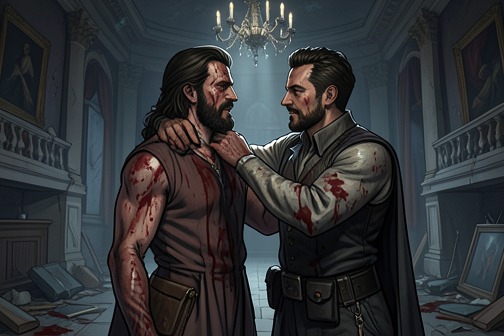
[Armand](entity:character-recall-character-a8d393c13b59)’s attack on [Lestat](entity:character-recall-character-lestat-1e494e73e33c) is a violent reversal of their long-awaited meeting: Armand drains Lestat, but Lestat breaks free, beats him nearly to death, and then carries him away rather than leaving him to the mortals who might find him. The encounter converts recognition into assault and rage into reluctant care, ending with Armand’s plea to leave [Paris](entity:location-recall-location-657453741ed3) together and Lestat’s refusal.
## The Encounter Turns Violent
At a gathering in Paris, Lestat glimpses Armand across the ballroom, radiant amid satin, filigree, jewels, and lace. The sight has the force of a revelation: Lestat recognizes the beautiful figure he has been waiting to meet. But the apparent reunion quickly collapses. Armand’s lips taste of the blood [Magnus](entity:character-recall-character-4069da87874e) gave Lestat, not human blood, and Lestat recoils as he realizes that Armand is feeding on him. Armand drains him while Lestat is paralyzed by the familiar rapture of the exchange; Lestat’s attempt to cry out breaks the paralysis, and he roars at Armand and hurls him away.
## Retaliation and Restraint
Lestat drags Armand through the shattered French doors and into the night, striking him until blood runs from his ears, eyes, and nose. He draws his sword and considers severing Armand’s head, then holds back. The wounded vampire lies in the rain, unable to move or plead; Lestat waits for him to speak, wanting the voice that had briefly made him believe he was alive and free to answer for what it had done. Armand says nothing. The pause does not erase the assault, but it interrupts the revenge Lestat had brought to its threshold.
The restraint is entangled with older pain. Lestat recalls the misery and despair surrounding Nicolas and [Gabrielle](entity:character-recall-character-f84321db0300)’s denunciations, and recognizes that his own anger is small beside Armand’s suffering. He gathers Armand up, moved both by his exquisite beauty and by the recognition that they belong to the same kind. The choice is practical as well as compassionate: mortals might soon find the helpless vampire and drive him away. Armand offers no resistance as Lestat steadies him and leads him from the Palais Royal toward the rue Saint-Honoré.
## The Journey to the Tower
Gabrielle and Lestat take Armand to the livery stables. Lestat puts him on his mare, then mounts behind him because Armand looks likely to fall; the three ride out together. During the journey, Lestat wonders what bringing Armand to his lair will mean. Gabrielle does not object, though she glances at Armand, and he remains silent, small and self-contained before Lestat. The encounter has brought the long-awaited meeting at last, but not the uncomplicated reunion Lestat might have imagined: Armand has just attacked him, and Gabrielle shares the journey without explaining her response.
At the tower, Armand asks Lestat to leave Paris and take him along. He says he no longer knows how to exist there and describes himself as stumbling through a carnival of horrors. Lestat answers no. Armand then asks whether he has no value to Lestat and turns to Gabrielle; her face is anguished and still. Lestat realizes that Armand is speaking to her in a way that shuts him out, but cannot know what passes in her heart or what she will answer. The episode ends not with reconciliation, but with Armand carried into Lestat’s refuge and a request to leave Paris that Lestat refuses.
## Significance of the Reversal
The encounter is shaped by a sharp change in what the meeting means. Lestat has waited for Armand, and the first sight of him seems to fulfill that expectation: Armand appears as a vision of beauty across a glittering ballroom. The attack overturns the promise of recognition. Armand’s feeding forces Lestat to experience the same rapture associated with his transformation, but now as an assault that strips him of control. When he breaks free, the violence reverses direction; his response is so severe that Armand is left helpless in the rain. Yet Lestat stops short of killing him, and the scene turns again, from vengeance to rescue. The shift does not settle their conflict. It leaves them bound by the very acts that divide them: Armand has injured Lestat, while Lestat has beaten him and then taken responsibility for his survival.
The aftermath also makes the reunion a crisis of choice rather than a simple return to an old hope. Lestat’s decision to carry Armand to the tower places the wounded vampire within his refuge, but Armand’s request to leave Paris together receives a refusal. Gabrielle’s silence and anguished expression sharpen the uncertainty: she accompanies them, yet Lestat cannot tell what she feels, and Armand’s appeal to her seems to exclude him. The episode therefore closes on unresolved attachment. Armand has been brought out of danger, but neither the attack nor the plea has produced reconciliation, and Lestat’s answer leaves their possible departure unsettled.
## Significance of the Reversal
The encounter is shaped by a sharp change in what the meeting means. Lestat has waited for Armand, and the first sight of him seems to fulfill that expectation: Armand appears as a vision of beauty across a glittering ballroom. The attack overturns the promise of recognition. Armand’s feeding forces Lestat to experience the rapture associated with his transformation, but now as an assault that strips him of control. When Lestat breaks free, the violence reverses direction; his response is so severe that Armand is left helpless in the rain. Yet Lestat stops short of killing him, and the scene turns again, from vengeance to rescue. The shift does not settle their conflict. It leaves them bound by the very acts that divide them: Armand has injured Lestat, while Lestat has beaten him and then taken responsibility for his survival.
The aftermath makes the reunion a crisis of choice rather than a simple return to an old hope. Lestat’s decision to carry Armand to the tower places the wounded vampire within his refuge, but Armand’s request to leave Paris together receives a refusal. Gabrielle’s silence and anguished expression sharpen the uncertainty: she accompanies them, yet Lestat cannot tell what she feels, and Armand’s appeal to her seems to exclude him. The episode closes on unresolved attachment. Armand has been brought out of danger, but neither the attack nor the plea has produced reconciliation, and Lestat’s answer leaves their possible departure unsettled.
Event 21
Armand’s abduction and enslavement
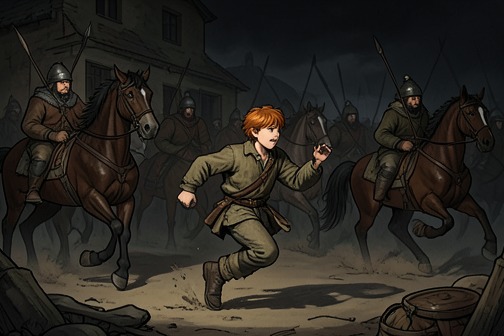
[Armand’s abduction and enslavement](entity:event-recall-event-armand-s-abduction-and-3142158c1953) is the formative rupture that removes him from his childhood home and subjects him to successive systems of captivity. The episode moves from his seizure by Tartar horsemen on the southern Russian steppes through the disorienting journey to [Constantinople](entity:location-recall-location-constantinople-a234f40d5eca) and, eventually, [Venice](entity:location-recall-location-venice-0377938b8d6a), where he is sold to the vampire who takes him away. Its significance lies not only in the distance [Armand](entity:character-recall-character-a8d393c13b59) travels, but in the progressive loss of any power to name, understand, or choose what happens to him.
## Capture on the Steppes
The remembered scene begins with horsemen appearing on the horizon. Their arrival turns quickly into a raid: an auburn-haired child in rough peasant clothing runs as they approach, but is caught and carried off. The child is Armand. He does not know that the land is the southern Russian steppes, cannot identify his captors as Tartars, and does not understand that the seizure will permanently separate him from everything familiar.
His knowledge is bounded by the words and authorities of childhood: Mother, Father, [Church](entity:organization-recall-organization-church-c786755b8de3), God, and Satan. He does not yet understand even the name of his home or of his own language. The abduction therefore takes away more than his physical freedom. It removes him from a world in which he has relationships and meanings, and places him in circumstances he cannot interpret or appeal against.
## Displacement and Captivity
After the capture, Armand is carried by ship toward Constantinople. The passage is recalled through darkness, the motion and sickness of the vessel, and the fear of a child surrounded by strangers. Constantinople appears to him as an immense and bewildering city, crowded with unfamiliar buildings and slave-auction blocks. He cannot distinguish the people around him as separate possible threats, much less understand their languages or gestures well enough to escape their control.
The narrative later supplies names and histories that Armand himself could not have known at the time. Officials of the Byzantine court, harem keepers, Mameluke warriors, and Venetian buyers emerge as possibilities in the wider traffic of captives, but the child experiences them simply as successive people with power over his fate. He is carried across the Aegean and Adriatic; during the voyage he resolves not to live. That vow records the depth of his despair, while also marking how little control remains to him beyond the wish to refuse the future imposed on him.
## Sale in Venice
Armand is taken to Venice and confined in a large house of secret chambers. He glimpses the sky only through barred windows and hears other boys speaking Venetian, a language he does not know. His captivity there is organized around the repeated arrival of strangers and the expectations imposed by his captors. When he resists, he is shut away; after days in a dark room, hungry, exhausted, and unwilling to speak, he is brought out and sent through another door.
There he meets a tall man dressed in red velvet. The man’s appearance is unfamiliar, and Armand sees money change hands: the price is conspicuously large. At the decisive moment, Armand cries out and pleads to be told where he is being taken, promising to obey. The sale makes explicit the transaction already governing his life: he is treated as property, and the person who has purchased him controls where he goes next.
## The Vampire’s Kiss and the Event’s Consequence
The purchaser is the vampire who becomes Armand’s new master. As Armand is taken downstairs toward the water, the man touches him gently and kisses his neck. The account presents this first vampire kiss as an overwhelming change in the meaning of the encounter: it is associated with love and cleansing even as it carries Armand away from the house and into another hidden space, by gondola through the waterways beneath a different building.
That contrast does not undo the coercive conditions of the abduction and sale. Armand has been seized as a child, carried far from home, held in captivity, and transferred to a new master without control over his destination. The vampire’s tenderness is thus part of the scene’s unsettling reversal: an act experienced as relief and affection arrives within a chain of forced displacement. The episode establishes the origins of Armand’s life under another’s authority and the stark divide between the child’s helplessness and the meanings he will later attach to the encounter.
Event 22
Marius turns Armand
[Marius turns Armand](entity:event-recall-event-marius-turns-armand-26911fa583ea) in [Venice](entity:location-recall-location-venice-0377938b8d6a) through a deliberate exchange of consent and vow: after months of growing into the work and rhythms of his household, [Armand](entity:character-recall-character-a8d393c13b59) accepts the [Dark Gift](entity:concept-recall-concept-dark-gift-8ccbb9152cb6) and promises to remain with his creator. The change makes their private bond into an immortal one, binding secrecy, night hunting, and artistic practice together, even as the wider story shows that other vampires understand initiation and its laws very differently.
## Armand’s Life in [Marius](entity:character-recall-character-marius-64ee8a1791fa)’s Household
Before the transformation, Armand had become an active participant in Marius’s Venetian household. He learned to read and write, delivered paintings to churches and chapels in great palaces, collected payments, and bargained for pigments and oils. He also scolded servants when beds or meals were not prepared, and the apprentices loved him; when their training ended, he sent them to new service with tears.
The household was a place of work and art, but also of dependence and separation. Armand read poetry aloud while Marius painted, learned the lute, and sang. When Marius left Venice for many nights, Armand governed in his absence and concealed his distress from the others, knowing that it would end only when Marius returned. The account sets this ordinary-seeming labor and longing beside the extraordinary permanence that Armand is about to choose.
## The Night of the Transformation
The turning is set in the small hours, when Venice is asleep. Marius presents Armand with a direct choice: to come to him and become like him. Armand answers yes. Marius then describes the life that acceptance entails: secretly thriving on the blood of evildoers and abiding with their shared secrets until the end of the world. Armand accepts those terms, surrenders himself to the change, and declares that being with Marius is his greatest desire.
The exchange is brief but carries the weight of a rite of passage. Marius speaks of creation and enduring companionship; Armand answers with a vow that converts attachment into a chosen, perpetual commitment. The scene does not present the Dark Gift as a solitary change of condition. Its terms include a way of living, a rule of secrecy, and a continuing bond with the vampire who creates him.
Marius points to the great painting rising above the tiers of scaffolding and tells Armand that it will be the only sun he sees again. In exchange, he promises a millennium of nights in which Armand will see light in a way no mortal has, drawing illumination from distant stars as Prometheus did. The painting thus marks the threshold between mortal life and the nocturnal existence ahead, while connecting Armand’s new vision to the artistic world already shared with Marius.
## Their Life Afterward
The narration looks back on the months following the change as a period of Armand reeling in the power of the Dark Gift. Marius and Armand drift together through alleys and canals, no longer afraid of the danger of the dark. Their shared life includes hunting, but the account distinguishes its chosen targets: they do not hunt the innocent, instead pursuing evildoers and discovering the wrongdoing in their victims’ minds before feeding.
Art remains central after the transformation. The pair return to painting, working furiously together on a triptych while their mortal apprentices sleep among the paint pots. This juxtaposition gives their immortality a particular texture: the night is a time of movement and hunting, but also of concentrated artistic labor. Armand’s new power does not erase the skills and responsibilities he acquired in Marius’s household; it carries them into a life shared with his creator.
## Secrecy and the Wider Vampire Order
The vow to keep secrets takes on added significance in a narrative where vampire secrecy is treated as a sacred law. [Lestat](entity:character-recall-character-lestat-1e494e73e33c) later reflects on the breach caused when [Louis](entity:character-recall-character-louis-b60a54ea5311), the narrator of *[Interview with the Vampire](entity:object-recall-object-interview-with-the-vam-7b53a6f85e48)*, tells mortal readers about vampires, names immortals, and gives clues to Lestat’s sleeping place. Against that disclosure, Armand’s promise to abide with Marius’s secrets establishes the turning as entry into a concealed community as well as a personal union.
Other accounts reveal that vampire initiations do not follow one uniform practice. In a dream, Lestat sees [Magnus](entity:character-recall-character-4069da87874e), then mortal, taking the blood of a captive sleeping vampire and becoming one of the living dead; Magnus’s own final instructions later emphasize the need to scatter his ashes and hide by day in a coffin. At a gathering of vampires, a speaker describes older [Rules of Darkness](entity:rule-recall-rule-rules-of-darkness-0808564fe307): fledglings were tested, given only a small infusion of an ancient vampire’s blood, sealed in graves, and expected to rise before being admitted to the ranks. These recollections are not details of Armand’s turning, but they place it in contrast with other models: Marius offers Armand a spoken choice and a promise of shared life, while other traditions emphasize ordeal, grave, and institutional discipline.
The scene therefore makes transformation both intimate and cultural. Armand’s yes secures a relationship with Marius, but his vow also accepts the obligations attached to their hidden existence. The image of the painting as his last sun gathers the change into a single emblem: artistic vision remains, but its future belongs to the night.
Event 23
The burning of Marius’s palazzo
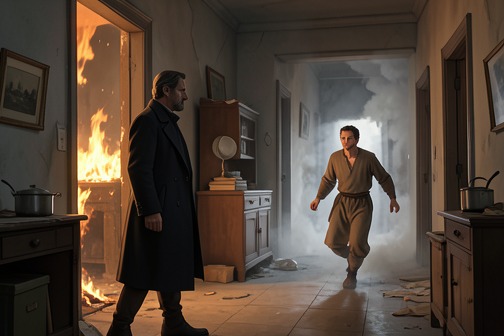
[The burning of Marius’s palazzo](entity:event-recall-event-the-burning-of-marius-s-fd96a6ad29a0) is a remembered attack in [Venice](entity:location-recall-location-venice-0377938b8d6a) that destroys the home [Armand](entity:character-recall-character-a8d393c13b59) shares with his Master and separates them under assault. Its decisive turn comes when [Marius](entity:character-recall-character-marius-64ee8a1791fa) recognizes that the attackers have arrived: he orders Armand to flee, but as the house burns, Armand is captured and Marius turns back to face the advancing crowd. The narrative leaves Marius’s ultimate fate unconfirmed in this scene, even as the fire makes his apparent loss the center of Armand’s forced departure.
## The Warning and the Flight
Less than half a year into what Armand remembers as a period of dark happiness, twilight brings Marius to Armand’s coffin in a cellar above the water. Marius tells him to rise because they must leave; when Armand asks whether the threat is the beings known as Those Who Must Be Kept, Marius says it is the others. That brief exchange establishes that Marius understands the danger before Armand does, but does not explain who the attackers are or why they have come.
The threat quickly surrounds the house. White faces appear at the windows, doors are pounded, and glass breaks. Marius looks toward the paintings as smoke and the smell of burning pitch signal that the invasion is coming from both above and below. He orders Armand to run and says there is no time to save anything. The urgency makes escape, rather than preserving their possessions or home, the immediate priority.
## The House Under Attack
The attackers are described as black-hooded figures carrying torches. Fire spreads through the rooms and up the stairway, while the windows burst and the paintings burn. Marius leads the way toward the roof, scattering attackers as he goes. The setting becomes a route of retreat with no clear refuge: the cellar, the rooms above, and the stairs are all overtaken by the assault.
The attackers identify Marius as a blasphemer and heretic. Their words frame the assault as punishment grounded in religious condemnation, rather than as an ordinary theft or private quarrel. The scene does not establish the full identity of the assailants or the events that prompted their attack; it does show them acting as an organized, torch-bearing group intent on reaching Marius and destroying his household.
## Separation and Uncertain Fate
Armand is caught and held as Marius reaches the upper stairway. Marius calls on him to trust his strength, but the attackers surround Marius in growing numbers. They set his clothing alight and he is consumed by the fire while attempting to defend himself and fight back. The account presents the apparent destruction of Marius as the emotional and visual climax of the attack, without establishing that he dies.
Meanwhile, Armand is carried away from the burning house along with the mortal apprentices. They are taken over the water and away from Venice, then brought to an open clearing beneath the night sky. The attackers’ cries and the encircling figures show that the assault continues beyond the palazzo. For Armand, the immediate consequence is not escape into safety but removal from Marius and transfer into the attackers’ custody.
## Significance in Armand’s Recollection
The episode is told through Armand’s recollection, so its focus is the collapse of his life with Marius: the short-lived sense of protection ends in a sudden flight, capture, and separation. Marius’s warning gives way to his attempt to protect Armand, while Armand’s brief question about Those Who Must Be Kept shows that he does not yet understand the danger around them. The burning house marks the boundary between their shared life in Venice and the ordeal that follows for Armand.
The scene also turns on what it withholds. Marius is engulfed by the fire, but the account provides no confirmation of his death; the attackers’ religious accusations explain their language, not the full cause of the violence. The destruction of the palazzo therefore establishes a presumed loss and a forced separation, while leaving Marius’s actual fate unresolved.
Event 24
Armand’s initiation into the Children of Darkness
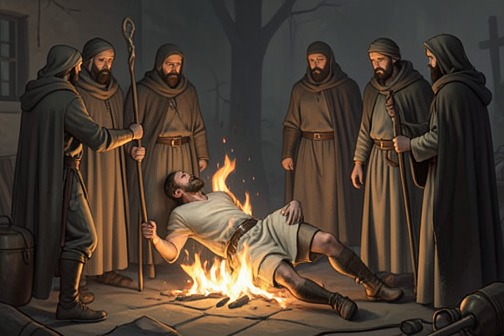
[Armand’s initiation into the Children of Darkness](entity:event-recall-event-armand-s-initiation-int-2d50d59bf1ca) transforms his rescue from execution into a new captivity: [Santino](entity:character-recall-character-santino-d8418ffb567a)’s followers preserve his life only by demanding his submission to their creed. The episode gives [Armand](entity:character-recall-character-a8d393c13b59) a new vampire community at the moment he has lost [Marius](entity:character-recall-character-marius-64ee8a1791fa) and the mortals he loved, while replacing his former life with an identity organized around obedience, destruction, and the coven’s account of its purpose.
## From the pyre to the coven
Armand is being killed alongside the mortal apprentices he regarded as his brothers. He pleads for the coven to stop because the apprentices are innocent, but he is thrown into the flames as well. He is then pulled from the fire and left alive, gravely weakened and unable to move freely. That reversal—death interrupted, but not undone—creates the opening through which Santino’s followers take control of what remains of his life.
The group presents Armand with a choice framed by his immediate vulnerability: destruction in the fire or service to Satan. Its leader declares Marius damned and insists that Armand’s master is gone. Armand must answer while in pain and afraid of further suffering; the episode makes clear that his agreement is obtained under threat, not as a considered choice between equally available ways of life.
## The terms of admission
The coven’s demands extend beyond a declaration of allegiance. Armand is ordered to abandon the artistic practices associated with his former life—not to paint, make music, dance, or perform for mortal amusement—and to use his Dark Powers only to seduce, terrify, and destroy. The oath recasts creative expression as forbidden vanity and makes destructive service the defining obligation of his new identity.
The initiation also tests what Armand knows about Those Who Must Be Kept. When the vampires demand that he reveal their whereabouts, he says he does not know and that he is afraid. The demand shows that admission is bound up with the coven’s search for protected ancient vampires, while Armand’s answer marks the limit of what he can provide. Afterward, the group tells him to take healing blood and rise among his new kind. He accepts it, and the blood brings the transformation toward completion.
## A new brotherhood, a lost master
Before dawn, a dozen members of the coven surround Armand, comfort him, and lead him down a staircase into the earth. The gesture offers care and collective belonging, but it follows the destruction of his previous attachments and the imposition of the coven’s terms. His incorporation is therefore double-edged: he is no longer alone, yet the community receiving him has demanded that he condemn Marius and relinquish the purposes that once gave his life meaning.
In the months that follow, Armand dreams that Marius survived, escaped into the canal, and now calls to him from the sanctuary of Those Who Must Be Kept. The dream gives form to a hope the initiation could not extinguish, even as Armand’s waking understanding is that Marius is gone. When he looks out at the moon, stars, and still sea, he finds no hope, grief, or joy in himself; he understands those feelings as having come from his master. The coven has gained his outward obedience, but the loss on which that obedience rests remains unresolved.
## [Rome](entity:location-recall-location-rome-3ec0a741c1f4) and the coven’s purpose
Armand is taken to the great vampire coven in the catacombs of Rome and presented to Santino, its leader. Santino recounts a vision from 1349, during the [Black Death](entity:time-recall-time-black-death-57117d6db3b1): vampires, he says, should become a human calamity that makes mortals doubt God’s mercy and intervention. He explains the coven’s history in a sanctuary lined with human skulls and describes it as the final perfection of the vampire order, a dark counterpart to the Roman [Church](entity:organization-recall-organization-church-c786755b8de3).
That teaching supplies a historical and religious rationale for the oath imposed on Armand. The initiation does not merely give him a new name or place among vampires; it makes him a participant in a doctrine that treats terrorizing humanity as a sacred mission. Its lasting significance lies in the contrast between the innocent people Armand tried to protect and the coven’s demand that he become an agent of cruelty toward both the guilty and the innocent.
Event 25
The fall of the Paris coven
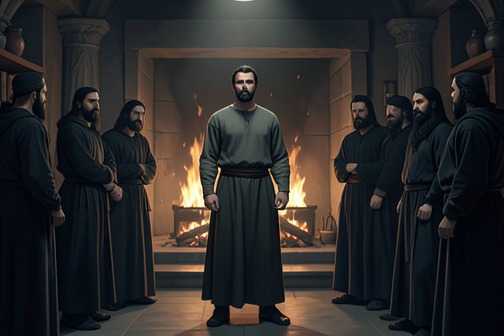
[The fall of the Paris coven](entity:event-recall-event-the-fall-of-the-paris-c-31bca6cd2c56) is the destruction of the old Parisian vampire order and a decisive break in [Lestat](entity:character-recall-character-lestat-1e494e73e33c)’s life there. The defeat frees him and [Gabrielle](entity:character-recall-character-f84321db0300) to leave, but its meaning extends beyond the city: the Roman coven knows that they destroyed the [Paris coven](entity:organization-recall-organization-679e37879574) and overcame [Armand](entity:character-recall-character-a8d393c13b59), yet responds not with condemnation but with questions about why the old order failed to change.
## Background and Social Setting
The coven’s fall takes place against the upheavals of late-eighteenth-century [France](entity:location-recall-location-france-f5cafc8a8ad4). Lestat had grown up as the youngest surviving son of a noble family whose fortunes had dwindled; there was no money to launch the ecclesiastical career that might have suited his rank. In [Paris](entity:location-recall-location-657453741ed3), he found a different life in the boulevard theaters, which stood outside the government-sanctioned houses reserved for serious drama. The theaters grew from fairground entertainments and mixed commedia, acrobatics, and popular spectacle, attracting both poorer audiences and wealthy spectators who preferred their liveliness to the stiffness of established drama.
That theatrical world gave Lestat a practical education in performance and a community apart from his family’s expectations. Nicolas’s bourgeois friends regarded their life as eccentric, while Lestat observed the irony that many bourgeois sought aristocratic titles even as the Revolution would help abolish the class they hoped to join. The coven’s eventual destruction thus belongs to a city already marked by old hierarchies under pressure, though the account distinguishes the vampires’ defeat from the later revolutionary violence against Lestat’s family.
## The Coven’s Defeat and Departure
After the Paris coven’s destruction, Lestat’s last eighteenth-century view of Armand is outside [Renaud](entity:character-recall-character-6a83719fd50c)’s theater. Armand stands with [Eleni](entity:character-recall-character-702d13f9e10d), Nicolas, and the other vampire mummers, watching the carriage carrying [Lestat and Gabrielle](entity:relation-recall-relation-lestat-and-gabrielle-fdeaba11ef28) merge into traffic on the boulevard. The image closes their immediate Paris chapter with a departure rather than a reconciliation: [Lestat and Armand](entity:relation-recall-relation-lestat-and-armand-69a05d5a3d59) have no final exchange in the scene, and the carriage moves away while the survivors remain at the theater.
Lestat had already found Armand in his old dressing room with Nicolas. Armand wore a wig and a sober red frock coat, and Lestat perceived in him a new opacity and increasing strength after the old coven’s death. At the parting, Armand accepted the keys to the tower and a substantial sum of money from Lestat, along with the promise that [Roget](entity:character-recall-character-1522d55fb028) would provide more if he needed it. These practical arrangements leave Armand with resources and a place in Paris even as the old coven’s authority has collapsed.
## What the Destruction Reveals
The event is also a rupture in the rules Lestat has been expected to obey. In May 1780, traveling south from Paris toward Lyons, he writes a message addressed to [Marius](entity:character-recall-character-marius-64ee8a1791fa), identifying the ancient vampire by name and asking him to make himself known. Lestat recognizes that putting an immortal’s name into writing violates the dark commandments. He nevertheless takes satisfaction in doing it, acknowledging his habitual resistance to rules. The collapse of the coven is therefore accompanied by Lestat’s own movement beyond the restrictions that had governed the old order.
The narrative later places the Paris defeat in a wider vampire context. When Lestat and Gabrielle enter [Italy](entity:location-recall-location-italy-85c2492cd54b), the Roman coven welcomes them and invites them to a Sabbat in the catacombs. Its members know that the pair destroyed the Paris coven and bested Armand, but they do not despise them. Instead, they cannot understand why Armand resigned his power or why the Paris coven failed to change with the times. Their response makes the fall more than a simple victory over an enemy: it exposes a crisis of adaptation within the old institution.
## Aftermath and Historical Echo
The Roman vampires’ customs contrast with the Paris coven’s failed order. Even amid elaborate ceremonies, they readily pass as human when it serves them. In [Rome](entity:location-recall-location-rome-3ec0a741c1f4), [Venice](entity:location-recall-location-venice-0377938b8d6a), and [Florence](entity:location-recall-location-florence-29107dc52cb3), vampires move through opera audiences, the corridors of great houses, and even taverns and wine shops, observing humans at close range. They often wear the costumes of their birth and display regal dress, jewels, and finery. The coven’s destruction has not erased vampire society; it has revealed that other communities negotiate secrecy and human contact differently.
The wider French crisis later reaches Lestat through a letter reporting that the Bastille fell on July 14 and that riots spread across France. Peasants and tenant farmers have risen against his father’s household; his brothers, their wives and children, and the defenders of the castle have been killed before it was looted. His father alone escaped and is now in [New Orleans](entity:location-recall-location-new-orleans-ac6617a07d7e), asking Lestat to come to his aid. This later news is not the fall of the Paris coven, but it echoes its image of a world’s structures giving way: the destruction of the vampire order precedes the violent collapse of the aristocratic family and social world from which Lestat came.
Event 26
The death of Nicolas de Lenfent
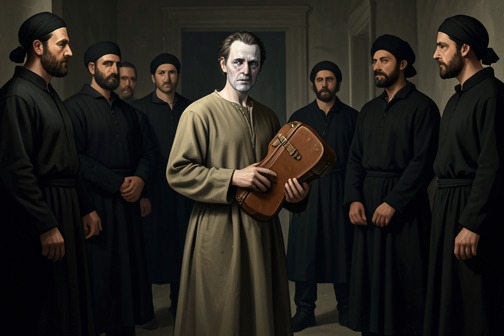
[The death of Nicolas de Lenfent](entity:event-recall-event-the-death-of-nicolas-de-942d6b628c62) is the culmination of his captivity, starvation, and return to the theater troupe: after asking his companions to gather for an ancient Sabbat, he gives [Lestat](entity:character-recall-character-lestat-1e494e73e33c) his violin and enters the flames. The account makes the death at once a private farewell and a deliberately staged communal rite, while the letter reporting it preserves the troupe’s grief and the theater’s transformation into a public emblem of vampire life.
## Circumstances and Release
A letter accompanying [Nicolas’s Stradivarius violin](entity:object-recall-object-nicolas-s-stradivarius-f80f2cbef7d5) tells Lestat that the Oldest Friend had imprisoned Nicolas in Lestat’s former residence. Nicolas was given his violin in his cell, but his hands were taken from him. The letter explains that, among vampires, such appendages could be restored; the Oldest Friend kept them safe, yet withheld sustenance from Nicolas for nights at a time. The troupe eventually prevailed upon the Oldest Friend to release Nicolas and return what had been taken from him.
The release did not restore Nicolas to his former self. The letter attributes his condition to pain and starvation, which had altered his temperament; he withdrew into an unbreakable silence that lasted a considerable time. His death therefore comes after an attempted return to life among the troupe, but not a recovery that the account describes as complete.
## The Sabbat and Nicolas’s Death
At last Nicolas came to the troupe and spoke only to say that he had arranged his business affairs in the manner of a mortal. He left the troupe a stack of newly written plays and demanded an ancient Sabbat in the countryside, with its customary blaze. He added that, without it, he would make the theater his funeral pyre. The Oldest Friend solemnly granted the request, turning Nicolas’s stated wish into a collective occasion rather than an act carried out alone at the theater.
The Sabbat brought together the vampire troupe in an unusually theatrical form. Its members wore wigs, fine clothes, and black ruffled vampire dancing costumes; they formed the old circle and sang the traditional chants with an actor’s bravado. Nicolas remarked that they should have held the rite on the boulevard, then placed the violin in Lestat’s hands and told him to send it to his maker. As the troupe danced to induce the customary frenzy, the letter’s writer recalls that they were deeply moved, afraid, and sad. Nicolas went into the flames, and the account presents his death as the close of the rite.
## Aftermath and Meaning
The letter stresses that the troupe had done what it could to prevent the outcome. The Oldest Friend was left bitter and grieving, and the survivors returned to [Paris](entity:location-recall-location-657453741ed3) carrying the consequences of Nicolas’s death. The violin, entrusted to Lestat at the Sabbat, became the object through which the news reached him; its arrival and the letter make the death a belated revelation rather than a scene Lestat witnesses directly.
Nicolas’s final request also changed the theater’s name. On returning to Paris, the troupe discovered that he had ordered it officially named the Theater of the [Vampires](entity:creature-recall-creature-vampires-1d7f37af175a), and that the words had already been painted on its front. Because his plays often featured vampires, werewolves, and other supernatural beings, the public treated the name as an amusing theatrical conceit and did not seek to change it. The result is an ironic public afterlife for Nicolas’s work: the theater bears the supernatural identity that its audience reads as a joke, while the troupe understands the name in the light of the death and ritual that followed his imprisonment.
Event 27
The storming of the Bastille
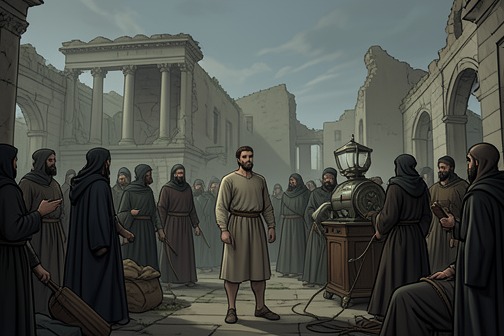
[The storming of the Bastille](entity:event-recall-event-the-storming-of-the-bas-db7940ab24cb) is presented as the opening signal of a wider revolution, but its decisive meaning for [Lestat de Lioncourt](entity:character-recall-character-lestat-de-lioncourt-0acd1217f0bb) is intimate and devastating: in the aftermath, he learns that insurgents have destroyed his family’s home and killed nearly everyone there. The report connects the collapse of aristocratic authority to the class-bound life that had already narrowed his family’s prospects, making public upheaval the cause of a private catastrophe.
## Background and Social Order
Before the Revolution, [Lestat](entity:character-recall-character-lestat-1e494e73e33c)’s family belonged to the French nobility but had little wealth left to sustain its rank. His father was a marquis; Lestat, the youngest surviving son, had no claim to the title or land, while his eldest brother, [Augustin](entity:character-recall-character-augustin-100d7b38f66c), was heir to what remained. The family’s finances were so depleted that Lestat hunted pheasant, venison, and trout to help feed the household, a responsibility that made his otherwise confined life materially necessary.
That inheritance system also shaped Lestat’s education and expected future. His family sent him to learn reading and writing, but Augustin explained that there was no money to launch him into a church career befitting their rank. Instead, Lestat was expected to accept a life with few prospects and attend to the family’s younger generation. The Revolution therefore strikes a household already caught between aristocratic status and economic decline.
## [Paris](entity:location-recall-location-657453741ed3) Before the Uprising
Lestat’s memories of Paris describe a society whose cultural institutions reflected its rigid divisions. Only the [Comédie-Française](entity:organization-recall-organization-com-die-fran-ais-83f46a9aebc1) and the Theatre des Italiens were officially sanctioned venues for serious drama, while boulevard theaters along the boulevard du Temple had grown from fairground entertainments. They drew both poorer spectators and wealthy aristocrats and bourgeois patrons, offering lively performances beyond the decorum of the grand houses.
The bourgeoisie’s relationship to aristocratic rank carried its own irony. Lestat observed that wealthy young bourgeois sought titles and aristocratic marriages, yet became involved in a Revolution that helped abolish the class they hoped to join. His account places the uprising within a larger reversal: social distinctions that had organized ambition and opportunity were becoming targets of political change.
## The News and Its Consequences
The event reaches Lestat through a letter, not through a scene of fighting at the Bastille. As he reads, he learns that on July 14 the Parisian mobs attacked the fortress and that the city was in chaos, with riots across [France](entity:location-recall-location-france-f5cafc8a8ad4). The letter then narrows the scale from national disorder to family disaster: peasants and tenant farmers had risen against his father’s house, killed his brothers, their wives and children, and everyone who tried to defend the castle, before looting it.
His father alone escaped. Loyal servants concealed him during the siege and later helped him reach the coast; by the time Lestat reads the letter, the marquis is in [New Orleans](entity:location-recall-location-new-orleans-ac6617a07d7e), in the former French colony of [Louisiana](entity:location-recall-location-e662c8ad18f8). Grief-stricken and among strangers, he begs Lestat to come to his aid. The account thus makes the uprising more than a change of regime: it destroys the family’s home and most of its members, while leaving Lestat with an urgent obligation to the one survivor.
## Narrative Significance
The letter’s movement from the Bastille to the burned-out family estate links revolutionary events to the consequences of inherited rank and property. The family that once possessed land, a castle, and a village is violently dispossessed by the people who lived and worked under that order. Lestat’s earlier lack of inheritance had already made him an outsider within his own class; the uprising now makes the class structure itself vulnerable to destruction.
Because the news arrives as a revelation, the Revolution enters Lestat’s story through a rupture in personal life rather than a political chronicle. The message first announces disorder across France, then names the dead, identifies the father’s escape, and ends with his plea. This sequence transforms distant upheaval into loss, survival, and a call to action.
Event 28
The massacre of the de Lioncourt family
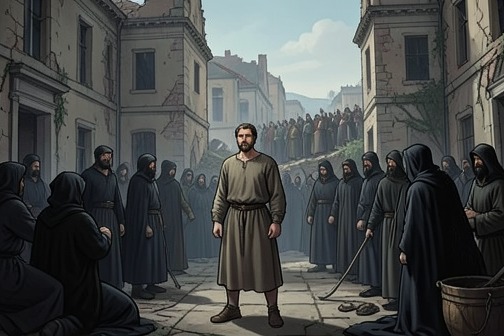
[The massacre of the de Lioncourt family](entity:event-recall-event-the-massacre-of-the-de-aa5fc05d2744) is the revolutionary destruction of [Lestat](entity:character-recall-character-lestat-1e494e73e33c)’s ancestral household: peasants and tenant farmers killed his brothers, their wives and children, and those defending the castle, then looted the estate. The news, delivered by letter, turns the Revolution from distant political upheaval into a personal catastrophe and leaves Lestat’s father as the sole reported survivor of the family’s attack.
## Background: A Declining Noble House
The violence falls on a family already weakened by poverty and inheritance. Lestat’s father was a marquis, but Lestat, the youngest of the three sons who reached adulthood, had no claim to the title or land. His eldest brother, [Augustin](entity:character-recall-character-augustin-100d7b38f66c), was heir to what remained, yet had spent his wife’s small dowry soon after marrying her. The family’s status therefore persisted alongside depleted resources and constrained prospects for its younger sons.
Those limits shaped Lestat’s own departure from the estate. His family sent him to learn to read and write, but Augustin made clear that they could not finance the ecclesiastical career befitting their rank; Lestat was expected to remain an impoverished teaching brother and fulfill duties toward his nieces and nephews. The household that the revolutionaries later attacked had already offered him little future, but it remained his home and the world of his childhood.
## Revolutionary Attack
The letter places the attack amid the countrywide upheaval following the storming of the Bastille on July 14. Its writer reports that riots had spread across [France](entity:location-recall-location-france-f5cafc8a8ad4) and that, on the preceding Monday, peasants and tenant farmers rose against Lestat’s father’s house. The defenders were overwhelmed: Lestat’s brothers, their wives and children, and everyone who tried to protect the castle were slain before the property was looted.
The report distinguishes the fate of the household from that of its patriarch. Loyal servants concealed Lestat’s father during the siege and later brought him to the coast. The letter says he had reached [New Orleans](entity:location-recall-location-new-orleans-ac6617a07d7e), in the former French colony of [Louisiana](entity:location-recall-location-e662c8ad18f8), and was grieving among strangers. He survived, but the home and family to which he belonged had been destroyed.
## The News Reaches Lestat
Lestat learns of the massacre through a letter accompanied by folded clippings from an English newspaper. He tears open the packet and reads that the writer had spent months trying, without success, to reach his family and get them safely out of the country. The message then delivers the decisive news of the rising and the killings, before pleading that Lestat go to New Orleans to help his father.
The account briefly supplies practical details, but Lestat can no longer take them in. He puts the letter on the desk and stares at the wood and the lamp’s pool of light. That stillness marks the immediate consequence of the news: political events that had seemed remote now demand a response to the loss of his family and his father’s appeal for aid.
## Significance
The massacre gives the [French Revolution](entity:time-recall-time-7fe2af46abc5) an intimate scale. The collapse of aristocratic authority is not presented only as a change in class relations: it reaches into one household, killing children as well as adult men and women, and leaving the surviving father displaced. The event also reverses the family’s earlier hierarchy of security. The de Lioncourts had possessed a castle and an inherited claim to rank, but neither could protect them from the uprising.
The letter links this catastrophe to the social order that preceded it. Lestat’s family had retained noble standing while lacking the money to secure his advancement, and young bourgeois acquaintances had sought aristocratic titles even as they became involved in the Revolution that abolished the class they aspired to join. Against that wider contradiction, the reported attack is both a political rupture and the destruction of the particular household from which Lestat had come.
Event 29
Lestat’s first death and rescue by Marius
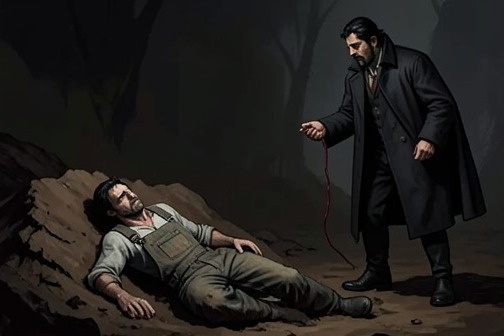
[Lestat’s first death and rescue by Marius](entity:event-recall-event-lestat-s-first-death-an-09736df91e40) marks the passage from [Lestat](entity:character-recall-character-lestat-1e494e73e33c)’s near-total physical collapse to his restoration by an older vampire whose power and apparent compassion distinguish him from the dangers Lestat has known. Buried in the earth and unwilling to surrender to thirst, Lestat dwindles until he can no longer rise; then a sound seeks him out, [Marius](entity:character-recall-character-marius-64ee8a1791fa) finds him, and offers blood. The rescue is at once bodily renewal and recognition: Lestat names the stranger, and Marius confirms his identity.
## Causes and Background
The episode’s emotional burden reaches back to Lestat’s life among the living. Born the youngest of the sons who survived to manhood in a once-wealthy family, he had no inheritance or prospects. His father’s estate in [Auvergne](entity:location-recall-location-auvergne-df7788427a46), in the final decades before the [French Revolution](entity:time-recall-time-7fe2af46abc5), was his narrow world; with the family’s resources depleted, Lestat hunted to help feed them. That early role as provider contrasts with his later helplessness beneath the earth: the young hunter who once supplied his household cannot now move himself to safety.
His family’s financial decline also narrowed the future available to him. [Augustin](entity:character-recall-character-augustin-100d7b38f66c) made clear that Lestat had been sent to learn to read and write, not to pursue a church career befitting the family’s rank. There was no money to make him a bishop or cardinal, and he was expected to accept a life of limited means and family duty. Lestat’s grief at supper, where he called the household “chaos,” reveals how deeply that confinement wounded him. The later crisis therefore follows a life shaped by constraint, frustrated ambition, and separation from the prospects he had imagined.
In [Paris](entity:location-recall-location-657453741ed3), the theater offered a counterworld to that inherited disappointment. The boulevard theaters were outside the government-sanctioned houses, which held the monopoly on serious drama, yet they drew audiences from both poor spectators and wealthy patrons. Lestat immersed himself in the lively performances and the practical work around them, learning by memorizing, mimicking, and asking questions. Nicolas played violin in the theater; his brief solo each night was part of the shared life Lestat valued. The memory of applause and Nicolas’s question about making people happy returns in the buried Lestat’s thoughts, carrying the vanished human world into his ordeal.
That human world is violently broken by the Revolution. On July 14, the Paris mob attacked the Bastille, and unrest spread through [France](entity:location-recall-location-france-f5cafc8a8ad4). A letter reports that peasants and tenant farmers rose against Lestat’s father’s house: his brothers, their wives and children, and those who defended the castle were killed before it was looted. Only his father escaped, reaching [New Orleans](entity:location-recall-location-new-orleans-ac6617a07d7e) in the former French colony of [Louisiana](entity:location-recall-location-e662c8ad18f8) and pleading for Lestat to come to him. The news places the burial and its aftermath against a second devastation: the loss of the family and home that had defined Lestat’s mortal life.
## Buried in the Earth
Lestat believes he is dying, but the account renders his condition as prolonged endurance rather than a clean ending. He cannot count the nights. He knows he must rise and travel to [Alexandria](entity:location-recall-location-alexandria-2b4cb64effda), yet movement would mean turning over in the earth and yielding to thirst. He refuses. The thirst comes and recedes, while his heart continues to beat with an agony he cannot escape.
The refusal has a terrible consequence. Lestat becomes, in his own description, little more than thirst lying underground, trapped in red sleep and dreams. He grows too weak to push through the sandy soil, and even the possibility of turning over seems beyond him. He continues to breathe and live, but not as a mortal would. His hands have become claws, his flesh has shrunk against his bones, and his eyes bulge from their sockets. The scene establishes that abstaining from blood does not release him from existence: it leaves him conscious of a continuing life reduced to weakness and pain.
Memories make that physical decline inseparable from loss. Lestat thinks of Nicolas as gone, of his brothers as gone, and of the theater’s wine and applause. The remembered exchange about whether their work made people happy carries a different weight under the earth, where Lestat’s survival has become an isolated burden. The question of goodness is not resolved by the scene; instead, the recollection sets the fragile human fellowship of the theater against the loneliness of his present condition.
## Marius Finds Him
The change begins when Lestat hears a sound like a cannon boom. He understands that it is searching for him and that he must answer. Though barely able to move his lips, he sends it a welcome and makes known that he is there. The sound grows stronger around him; the earth shifts, and the ruined house above becomes part of the unseen visitor’s approach.
Digging through the sand reaches Lestat before he can free himself. Something soft brushes his face, and he sees the dark sky and clouds overhead. Air and light, which had become inaccessible, return as immediate signs of release. The sound that led Marius to him fades into the aftersound of a violin string. This progression—from the distant, forceful signal to a quieter musical resonance—joins the rescue to Lestat’s remembered life around music without explaining the sound beyond its role as the means by which Marius locates him.
The figure standing over Lestat appears unlike the vampires he has known. Lestat sees a man in red velvet, with a ground-length cloak, red gloves, and thick hair streaked white and gold. His broad face and blue eyes convey an impression of gentleness and peace. Lestat regards the figure’s patience and compassion as qualities foreign to his own kind, even as the stranger lifts him from the earth. The scene’s contrast is decisive: after an ordeal defined by isolation and refusal, rescue arrives through a presence Lestat initially cannot reconcile with vampirism.
## Blood and Recognition
Marius tells Lestat to drink, exposing the vein at his throat. The offered blood restores Lestat with a force that reverses his underground wasting: strength gathers in his arms, and the blood spreads through his body. Lestat understands the blood as carrying power accumulated across centuries. The act is not merely a means of escape from the immediate crisis; it binds the weakened vampire to the older one whose blood revives him.
The recognition is spoken plainly at the close of the encounter. Lestat says “Marius,” and the stranger answers “Yes.” In that exchange, the rescuer becomes an identified person rather than an inexplicable presence. Marius has found Lestat, drawn him out, and given him blood; Lestat, restored enough to recognize and address him, receives the answer that confirms their connection.
## Consequences and Significance
The rescue reverses the apparent finality of Lestat’s burial without erasing what preceded it. The Revolution has destroyed the family home and killed Lestat’s brothers and their households; Nicolas is also remembered as lost. Marius’s intervention restores Lestat’s capacity to continue, but it does not return him to his former life. The crisis instead opens a new relationship and a new phase in his existence.
As a narrative turning point, the episode places vulnerability at the center of Lestat’s encounter with an ancient vampire. Lestat’s refusal to feed leaves him unable to act, while Marius’s call and offered blood make survival depend on contact with another being. The scene thus shifts the meaning of endurance: Lestat persists beneath the earth, but persistence alone cannot lift him from it. His naming of Marius, followed by Marius’s confirmation, gives the rescue its lasting shape—not only a return from near-death, but the beginning of a bond that will matter to Lestat’s subsequent history.
Event 30
Akasha and Enkil’s Transformation
[Akasha and Enkil’s Transformation](entity:event-recall-event-akasha-and-enkil-s-tran-c10b3eee862e) explains how the royal couple became the first blood drinkers and established the origin that later vampires struggle to interpret. In [Marius](entity:character-recall-character-marius-64ee8a1791fa)’s account, their new existence arises not from a planned rite but from an attack at a moment when mortal life is nearly extinguished: a spiritual presence enters their blood, animating bodies that are otherwise dead. Their transformation brings extraordinary capacities and an inescapable need for blood, while fire and sunlight remain fatal threats.
## Causes and Background
Before the transformation, [Akasha](entity:character-recall-character-akasha-ad2506c2932a) and [Enkil](entity:character-recall-character-enkil-9dd4acc460cb)’s conduct had become a source of political conflict. The King’s former military opponents resented his goodness, his concern for the Good Mother, and his turn toward farming. They viewed his engagement with spirits as both further evidence of what they considered his foolishness and an opening to advance their own interests. Their decision to enter the haunted house was driven by that combination of hostility and opportunity, not by a wish to create vampires.
Inside, they found Enkil and Akasha together amid supernatural disturbances. The conspirators attacked both rulers, leaving them gravely wounded. Enkil understood the attack as more than an attempt on their lives: he cried out that the violence had opened his body to the spirits. The attackers fled, convinced that the King and Queen were dying, while Akasha stayed beside her husband. The episode’s crucial threshold is the moment when mortal life is almost gone and the presence can enter the blood.
## The Transformation
When the conspirators returned with the populace and priests, Enkil and Akasha were standing calmly, their wounds healed. Their appearance had changed, and their eyes, skin, and hair displayed signs of their altered state. They dismissed the people and priests and withdrew to the palace, understanding privately that something had happened to them, though they did not confide in anyone.
Marius’s later explanation distinguishes the spiritual presence from the blood that carries it. The presence entered them through their wounds as their hearts were close to stopping, but what took hold was a combination of human and spiritual substance. The blood was neither simply the presence nor simply the couple’s human blood; it became something new. The presence had gained a way to inhabit the world and to feel through living bodies, while the King and Queen’s minds and identities endured through the organs the blood continued to animate.
That survival was also a profound loss. Their bodies were dead for other purposes: they could no longer eat ordinary food, grow, die in the usual way, or have children. Yet they could feel with an intensity that frightened them, and their minds were enlarged by the spiritual powers carried in the blood. They could perceive mortal thoughts and apprehend things beyond ordinary human understanding. The account therefore presents their change as neither simple resurrection nor possession: they remain themselves, but in a radically altered form whose powers and limitations are inseparable.
## Blood, Hunger, and Vulnerability
The couple soon discovered that their animated bodies required feeding. The blood sustaining them could make use only of the same substance from which it had been formed: blood. Drinking renewed and enlarged the force within them, and the act brought awareness of the victim’s death as the heart stopped. The need was not an incidental appetite that they could set aside; it was the condition on which their continued animation depended.
Their new existence also carried immediate physical limits. Fire and sunlight could not be endured: Marius describes their bodies as susceptible to the sun’s heat and the blood as volatile under heat, threatening the structures through which it moved. The earliest vampires were reportedly vulnerable even to nearby fire. Thus the transformation bestowed heightened perception and intense sensation while binding the first blood drinkers to hunger, darkness, and danger.
## Meaning and Later Accounts
The origin remains an event interpreted through different layers of the novel’s narration. Marius presents it as an explanation of how vampirism began, but the account itself preserves uncertainty: the presence’s own knowledge or intention cannot be established, and the precise nature of its agency remains beyond what the couple could discover. The transformation is consequently an accident of timing and circumstance as much as a supernatural origin—a presence enters at the threshold of death, and the resulting blood creates a new order of being.
This account differs from the later vampire rule that immortality is bestowed through another vampire’s blood. A separate explanation describes an ancient initiation in which fledglings receive a small infusion, undergo the terror of the coffin, and emerge subject to the [Rules of Darkness](entity:rule-recall-rule-rules-of-darkness-0808564fe307). Akasha and Enkil’s first transformation precedes that organized practice: it is not a deliberate initiation, and no established vampire community authorizes it. Their story supplies the origin later customs attempt to regulate, while leaving the foundational event itself strange and only partly knowable.
Event 31
马吕斯在萨温节成为血饮者
[Marius](entity:character-recall-character-marius-64ee8a1791fa)’s initiation at [Samhain](entity:time-recall-time-samhain-1db6a6af1bfe) is the turning point at which he becomes a vampire and is assigned a destiny that the old [God of the Grove](entity:character-recall-character-god-of-the-grove-4f631b22df9e)’s inherited religious system cannot contain. The god transfers the Blood and its powers to Marius, binds that transformation to a command to travel to [Egypt](entity:location-recall-location-egypt-831f7ba4f646), and sends him back to the worshipers as the apparent fulfillment of their seasonal rite. The ceremony restores Marius as a public god while making his departure urgent: his new immortality belongs to him, but its meaning and use remain contested.
## The God’s Charge and the Coming Crisis
The dying God of the Grove tells Marius that the gods of darkness have been devastated by an unnatural sun, which has reached sanctuaries where they were once protected. The oldest gods survive, but in an agonized, burned state; the younger ones have perished. The god offers Marius his power and immortality, but makes the gift conditional on escape and investigation. Marius must go to Egypt to discover what has happened and how it might be prevented, since the same disaster could reach him wherever he hides.
The timing is essential. Marius is told to leave that very night, before the worshipers can imprison him in the sacred oak after the festival. The god promises to tell the people that Marius must go to Egypt for their salvation, while warning that they will be reluctant to surrender their new and capable god. He also instructs Marius to seek refuge in the earth before sunrise. The initiation thus begins as a transfer of supernatural power but is shaped from the outset by a practical escape plan and a larger duty.
## The Transfer of the Blood
Without waiting for Marius’s agreement, the old god attacks and begins the exchange. Marius experiences the first influx of the Blood as ecstasy, but the transformation is not a single, finished act. Over hours inside [the oak](entity:object-recall-object-f9521be3bcc2), the god repeatedly takes Marius’s blood and gives it back. Each withdrawal leaves Marius weak and depleted; each return restores him to an intense, temporary fullness. The initiation’s repeated rhythm makes the change a prolonged passage between mortal life and a new condition rather than a simple bestowal.
With each exchange come lessons about what Marius has become. He is immortal, does not suffer illness or natural death, and can be killed only by the sun or fire. He must sleep in the earth by day. The god also teaches him that his soul will not migrate into another form, and that the moon gives him strength. These rules offer Marius a first account of his changed existence, even as he recognizes that the transformation has carried him beyond what the old teachings can fully explain.
The god’s instructions define the obligations attached to his new powers. Marius is to serve the Mother, drink the blood of wrongdoers and of those sacrificed to her, and remain starved between sacrifices. He is forbidden to drink any other blood or to use his powers for himself. His mind-reading abilities are intended for judging others and guiding the worshipers’ justice and laws. But the narrative distinguishes these imposed religious rules from the deeper fact of his transformation: Marius understands that he is no longer mortal and that his destiny exceeds the knowledge available to either mortals or immortals.
## Return as the Festival God
After the exchange, the god leaves Marius too depleted to stand securely and tells him to place himself in the worshipers’ hands. Marius emerges from the oak and announces himself to the waiting [Druids](entity:organization-recall-organization-druids-9eecec562641) as their god. His appearance confirms their expectation that the god has made a successor: he is visibly exhausted and ravenous, yet the people receive him as proof of divine continuity. Through his new perception, Marius sees [Mael](entity:character-recall-character-mael-87a192844fad)’s relief and the confirmation of belief that his survival provides.
The Druids lead him in procession toward the Samhain altars. They greet him with flowers, hymns, and acclamation, and the crowd answers the priests’ cries from beyond the sacred grove. The ceremony casts Marius’s weakened, newly transformed state as part of a seasonal renewal: the god is expected to drink, regain vitality, and bless the harvest and the seed. The rite supplies public recognition to a transformation that has so far taken place in secrecy and suffering.
At the altar, prisoners are brought to a silver cauldron, while three selected young men, dressed in white and adorned with flowers, are presented to Marius. He gives the signal for the sacrifices to begin. The festival combines several forms of death: some victims are killed by Marius, others are drowned, and others are sent to the burning wicker giants. Marius drinks not only from the three chosen victims but from many more as the ceremony continues. The scale of the rite makes clear that the community’s religious order depends upon violence as well as seasonal symbolism.
## Judgment, Contradiction, and Significance
When the sacrifices end, Marius is expected to judge disputes. Using his new ability to perceive people’s inner thoughts and intentions, he identifies who is just or mistaken, innocent or deserving of death. He carries out the role assigned to him, but its authority is inseparable from the same violent ritual that has revived him. His supernatural gift makes him an instrument of the community’s law even as he has already been told that he must not use his powers for himself.
The initiation therefore brings Marius into a position that is both exalted and provisional. To the Druids, he is the renewed God of the Grove, restored through the festival’s sacrifices; to the old god, he is a messenger who must leave, evade confinement, and seek answers in Egypt. The ceremony’s apparent completion conceals its decisive consequence: Marius has acquired immortality and the power to judge, but cannot remain within the role the worshipers have prepared for him. His new life begins under the tension between ritual belonging and the command to escape.
Event 32
马吕斯逃离高卢圣林
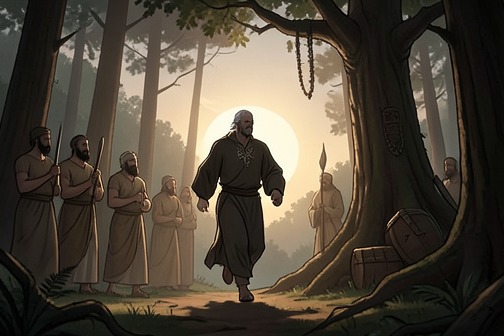
[Marius](entity:character-recall-character-marius-64ee8a1791fa)’s escape from the sacred grove is the decisive rupture between the sacred office the [Druids](entity:organization-recall-organization-druids-9eecec562641) intend for him and the solitary life he chooses after his transformation. When the priests move to burn the old god and hold Marius in place, he uses their expectation that he will grieve as a means of escape. His flight reveals the power he has not yet learned to control, but it also leaves him with the central problem of his new existence: he must feed, and even when he chooses evildoers, he cannot dismiss himself as anything other than a bringer of death.
## The Sacred Role He Rejects
After the Feast of [Samhain](entity:time-recall-time-samhain-1db6a6af1bfe), the Druids lead Marius back toward the sacred tree. Their hymns have become a litany directing him to remain within [the oak](entity:object-recall-object-f9521be3bcc2), sanctify the forest, serve as its guardian, and speak through it to priests who seek guidance. This future would make him the successor to the old god in a ritual order that confines him to the tree and subjects his nights to hunger until the next full moon.
Marius has already decided that these secrets are not for him. He understands that remaining in the oak means enduring prolonged thirst and learning the mysteries of the tree and the silent Mother, but he does not want the priesthood’s explanation of what has happened to him. Instead, he tries to make the assembled Druids leave the grove, claiming that he will enter the oak at dawn with the old god. His attempt fails: the priests look to one another, and the ritual procession turns into a seizure of control.
## The Old God’s Death and Marius’s Feigned Grief
The priests divide their actions. Some run to the tree, while roughly twelve seize Marius by the arms and legs. He calls on [Mael](entity:character-recall-character-mael-87a192844fad) to stop them, but Mael leads the group at the tree, and the old god is carried out and thrown onto a pyre. Marius does not yet understand how much strength he possesses; still shaken by the feast and horrified by what is happening, he struggles ineffectually as the priests hold him.
For a moment, he sees the old god’s resignation: the figure does not resist or look toward Marius. As the fire takes him, the old god tells Marius to do as commanded and calls him their hope. Marius understands this as an instruction to escape. He does not immediately break away. Instead, he becomes still, weeps, and acts like a grieving victim of the Druids’ magic. When their attention turns to the pyre and their grip relaxes, he pivots and tears himself free. His escape therefore depends not only on new strength but on reading the crowd and concealing his intention until the moment to act.
## Flight Through the Forest
Marius’s first sprint reveals the scale of his abilities. He crosses hundreds of yards almost instantly, with his feet scarcely touching the ground, while the crowd gives chase and cries that the god has flown. He tears off his white robe as he runs, leaps into the branches, and moves through the treetops. Within minutes he has outdistanced the pursuers, though he continues until the only remaining danger is the morning sun.
The flight also teaches him how to survive daylight: like [Gabrielle](entity:character-recall-character-f84321db0300) during her wanderings, he can dig into the earth for shelter. This discovery gives the escape a second consequence beyond immediate safety. The grove’s ritual had promised to contain him within a sacred tree; in the forest, he learns that he can use his own strength and the earth itself to evade the light and refuse that assigned place.
## From Escape to a Self-Directed Quest
Marius does not feed during the night of flight. By early morning, however, he encounters a band of thieves in the woods and takes blood from an evildoer, as well as a suit of clothes. The encounter offers a practical means to continue, but it does not settle the moral problem of feeding. Marius has chosen a victim he considers wicked, yet his conscience remains too sensitive to allow him to treat killing as an uncomplicated necessity.
He decides to go to [Egypt](entity:location-recall-location-egypt-831f7ba4f646) to discover what has happened, not to serve the gods or their worshippers. Within a month of the Samhain feast, he is in [Alexandria](entity:location-recall-location-alexandria-2b4cb64effda), searching for the old gods. The purpose of that search is both intellectual and personal: he wants to understand the threat of the sun god, but he also cannot bear to remain alone among human beings while he is now, in his own judgment, their relentless bringer of death. The escape thus launches a quest for knowledge without offering absolution. Marius leaves the grove’s imposed sacred order, but carries its loss, his thirst, and the consequences of his new nature into the world beyond it.
## Narrative Significance
The scene reverses the ceremony’s apparent meaning. Marius is hailed as a god and directed toward a consecrated tree, yet the ritual’s climax is the old god’s death and Marius’s flight from the role prepared for him. The grove’s authority cannot contain him; the community’s cry that its god has flown names both the apparent miracle and the collapse of its control.
The escape also establishes a pattern in Marius’s account of his early vampiric life: power opens a way forward, but does not make that way morally simple. His new speed and strength free him from the priests and the pursuit, while his need for blood brings him face to face with the harm his survival entails. His departure is therefore more than a successful evasion. It is the beginning of a self-directed search shaped by refusal, grief, and an unresolved conscience.
Event 33
马吕斯将阿卡莎与恩基尔带离埃及
The Removal of [Akasha](entity:character-recall-character-akasha-ad2506c2932a) and [Enkil](entity:character-recall-character-enkil-9dd4acc460cb) from [Egypt](entity:location-recall-location-egypt-831f7ba4f646) is the turning point at which [Marius](entity:character-recall-character-marius-64ee8a1791fa) becomes the ancient pair’s protector. After Akasha reaches him in [Alexandria](entity:location-recall-location-alexandria-2b4cb64effda) with a direct plea for rescue, he finds her and Enkil in their underground chamber, carries them out in painted mummy cases, and hides them beneath his garden. The act begins as a response to danger, but it also binds Marius to the beings at the center of vampire history and draws him into conflict with the Elder, who seeks their destruction.
## The summons from the hidden chamber
Marius first senses an extraordinary presence in his room: a bronze-skinned Egyptian woman, elaborately dressed and jeweled, whose force fills the small space. She silently tells him, “Marius, take us out of Egypt.” The message changes the direction of his life. He hurries toward the underground temple, initially intending to enlist the Elder, but recognizes that he can find the woman by going out into the desert. Her summons leads him instead to a ruined temple and a concealed entrance beneath the sand.
In the dark passage below, Marius encounters Enkil before he can see him clearly. The body feels human in shape but unlike ordinary stone, and the recognition that the figure is Enkil makes Marius hesitate. A torch then reveals Enkil standing in pharaonic dress, ornamented like Akasha and apparently alive in his eyes while otherwise still. Akasha lies on a stone shelf behind him, her linen soiled with sand and her posture resembling that of a dead body. Their condition makes the request for rescue difficult to reconcile with what Marius sees: the pair seem inert, yet Akasha has reached him and asked for help.
## Akasha’s appeal and the decision to act
Akasha makes her plea again as a thought inside Marius’s mind. She asks him to take her and Enkil out of Egypt, says the Elder means to destroy them, and urges him to guard them. The appeal clarifies the danger and gives Marius a specific responsibility. He understands that the Elder is not merely a source of information about the ancient pair; he is a threat from whom they must be removed.
Akasha then moves Enkil. She appears behind him and, while keeping close behind his body, makes him back away; soon afterward the two are seated together again in their former stillness. Marius sees that Akasha can produce movement even though she soon returns to silence and immobility. The episode intensifies his awe and grief. He recognizes her as a silent, vulnerable progenitor, isolated in a chamber beneath a country whose life has continued above her. Her appeal is not an explanation of who she is so much as an urgent demand that Marius act before the Elder destroys her and Enkil.
## The removal and concealment
Marius prepares to move the pair without relying on the Elder. He breaks into a shop selling antiquities and takes two painted, gold-plated mummy cases, along with linen for wrapping them. He approaches Akasha and Enkil knowing that Akasha will permit the plan and that Enkil could overpower him, but both allow him to wrap them and place them in the cases. The painted coffins, bearing funerary imagery and instructions for the dead, let Marius transport the pair out of their chamber in a form suited to the ancient Egyptian setting.
Once he reaches Alexandria, Marius hires men to carry the coffins to his house. He buries Akasha and Enkil deep beneath his garden and speaks aloud to reassure them that their stay underground will not be long. The concealment gives him a temporary means to protect them while keeping their location from the Elder. Yet leaving them is dangerous: Marius later hunts close to his garden gate and prepares horses and a wagon for a journey toward [Antioch](entity:location-recall-location-b60ee0e4eb5a), a city on the Orontes River where he believes he may be safer. His precautions show that the removal does not end the threat; it relocates the danger to Marius’s own home and makes concealment part of his guardianship.
## [The Elder](entity:character-recall-character-the-elder-808d94fa34bd)’s attack and Akasha’s power
The Elder finds Marius, attacks him, and tries to force him to reveal where Akasha and Enkil are hidden. As Marius escapes toward the garden door, the Elder’s attention shifts to Akasha. She has emerged from the earth with her wrappings torn and approaches him while he is unable to get away. Marius witnesses her kill the Elder, after which she destroys what remains of him with a lamp and its flame. The violence confirms that Akasha is not simply a helpless captive: even after appearing inert, she can act decisively against the person threatening her.
When the fire dies, Akasha returns to silence and stillness without acknowledging Marius. The attack therefore resolves one immediate danger but does not make her condition ordinary or fully understood. Marius has succeeded in removing her and Enkil from the chamber and concealing them, yet his protection has brought him face to face with the Elder’s pursuit and with the force Akasha can unleash. The removal marks the beginning of his role as their guardian: a choice made in response to her plea, sustained through secrecy, and shadowed by the danger of the power he has undertaken to protect.
Event 34
Lestat’s blood exchange with Akasha
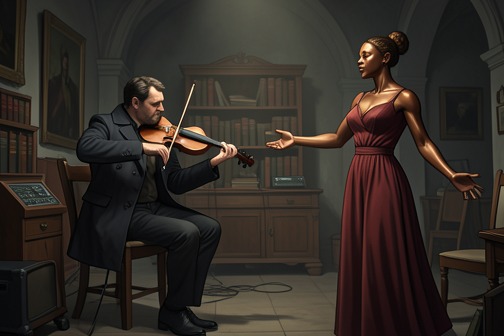
[Lestat’s blood exchange with Akasha](entity:event-recall-event-lestat-s-blood-exchange-17ea20b924d5) is a turning point in the sanctuary: his attempt to make music for the ancient vampires awakens [Akasha](entity:character-recall-character-akasha-ad2506c2932a), and the encounter becomes a mutual exchange of blood before [Enkil](entity:character-recall-character-enkil-9dd4acc460cb) separates them and [Marius](entity:character-recall-character-marius-64ee8a1791fa) drives [Lestat](entity:character-recall-character-lestat-1e494e73e33c) to escape. The scene binds Lestat to Akasha through an experience that he understands as intimate and transformative, while leaving him exposed to Enkil’s force and dependent on Marius’s intervention.
## Awakening Through Music
Lestat approaches the silent figures with a violin, explaining that he wants them to hear it even though he does not know how to play. He takes his cue from the music of Nicki, remembering the way Nicki’s body and fingers had served the music. As Lestat plays, however, the performance becomes his own: he loses himself in the sound and discovers that he can make a song.
The music’s rising intensity is answered by a sound Lestat recognizes as not his own. Akasha has risen from the steps of the tabernacle and is moving toward him with her arms outstretched. Her voice overwhelms the scene, and Lestat drops the violin. What began as an offering of music has become an encounter with a newly awakened presence; the violin opens the scene, but the connection that follows is made through blood.
## The Mutual Exchange
Akasha draws Lestat toward her, and he drinks from her while she drinks from him. Lestat experiences the exchange as reciprocal rather than as an ordinary act of feeding: the blood moves in both directions, and his attention narrows to the joined flow between them. The scene’s intimacy is expressed through this mutuality and through his sense that Akasha is at once mother, lover, and powerful being. These are Lestat’s perceptions in the encounter, not a neutral description of the relationship beyond it.
The transfer marks a decisive change from watching and trying to communicate with the ancient figures to being physically joined to one of them. For Lestat, the exchange seems to suspend everything outside their connection. Yet that apparent enclosure is fragile. The moment does not remain private or uninterrupted: Enkil intervenes, and the exchange is forcibly broken off.
## Enkil’s Intervention and Marius’s Rescue
Enkil seizes Lestat and pulls him away from Akasha. The separation is abrupt, and Lestat sees Akasha reach toward Enkil as the two ancient figures respond to the interruption. He calls out a threat against Enkil, but the immediate balance of power is not his to control. Marius then appears, places his hands on Enkil’s shoulders, and holds him in place while Lestat struggles to recover.
Marius directs Lestat to run, repeating the command without turning toward him. Lestat obeys. The exchange therefore ends not in a settled alliance or continued contact, but in separation and escape. From the terrace, Lestat remains acutely aware of the encounter and fears that Enkil may pursue him; the blood exchange has intensified his connection to Akasha without resolving the danger surrounding it.
## Significance
The scene joins artistic expression, awakening, and blood exchange in a single sequence. Lestat’s music is not merely an attempt to address the ancient figures: it coincides with Akasha’s awakening and precipitates a direct encounter. The exchange then turns that artistic approach into a relationship defined, in Lestat’s experience, by reciprocal blood and overwhelming closeness.
At the same time, the intervention by Enkil and Marius prevents the moment from becoming a simple union. Akasha’s approach, Enkil’s interruption, and Marius’s order to flee establish the encounter as both an intimate connection and a source of immediate peril. Its outcome is an enduringly charged bond in Lestat’s account, but the scene itself closes with his escape rather than with any confirmed agreement or settled consequence between him and Akasha.
Event 35
Louis与Claudia在巴黎受审及Claudia被处决
The [Paris](entity:location-recall-location-657453741ed3) trial of [Louis](entity:character-recall-character-louis-b60a54ea5311) and [Claudia](entity:character-recall-character-claudia-e57ffb0cea25), as recalled by [Lestat](entity:character-recall-character-lestat-1e494e73e33c), is a betrayal disguised as justice: [Armand](entity:character-recall-character-a8d393c13b59) forces Lestat to testify against Claudia, Claudia is executed, and Armand refuses Lestat’s plea to save Louis. The scene is not presented as a steady account but as a broken return to captivity, where fragments of the tribunal, Claudia’s dress, and unanswered questions reveal how the trial continues to govern Lestat’s grief.
## Background and Recollection
The episode reaches the reader through Lestat’s memory of a period when he is imprisoned and weakened. In a brick-lined cell, he suffers from hunger and discovers that a mortal victim there is already dead. Armand then appears in the shadows, dressed in white linen and black wool, and tells Lestat that Louis and Claudia will face some kind of trial. The new vampires gather at the cell door to look at Lestat one by one, turning his confinement into the prelude to a public demand for testimony.
Armand’s manner combines familiarity with control. He kneels beside Lestat and tells the others to find him clothes so that he will look presentable, calling him their lost lord. When Lestat asks to speak with [Eleni](entity:character-recall-character-702d13f9e10d), Felix, or Laurent, the gathered vampires do not recognize the names. The scene establishes Lestat’s isolation before the trial’s central betrayal: he is dependent on the same group that will use his words against Claudia.
## The Tribunal and Forced Testimony
The trial appears in Lestat’s recollection as a mob tribunal. White-faced vampires shout accusations, Louis pleads desperately, and Claudia remains silent. Under Armand’s pressure, Lestat agrees that Claudia was responsible. He then curses Armand as Armand pushes him back into the shadows and tells him that he has done well. Lestat’s own questions—what he has done, and whether his testimony means that Louis and Claudia broke the old rules—show that he does not experience the statement as a clear act of justice. It is a coerced declaration whose meaning and consequences are controlled by Armand.
The tribunal’s appeal to rules gives the proceedings an appearance of judgment, but Lestat’s memory emphasizes the imbalance of power rather than a fair hearing. Armand dictates what Lestat must say; the assembled vampires listen; Louis pleads; Claudia says nothing. Lestat is made both witness and instrument, and his testimony does not secure either companion’s safety.
## Claudia’s Execution and the Dress
After the tribunal, Lestat’s recollection shifts to a carriage journey in the rain and then to a tower roof. He holds Claudia’s bloody yellow dress and remembers seeing her in a narrow, wet place where the sun had burned her. He recalls having called for her ashes to be scattered, but no one moved to do so. The dress carries the aftermath of the execution into the next scene: Claudia is absent, while the object remains in Lestat’s hands as a stark reminder that his plea was not answered.
Armand asks whether Lestat wanted justice. The question sharpens the gap between the tribunal’s stated authority and what Lestat has witnessed. The dress does not resolve that question; instead, Lestat struggles to understand why he is holding it and what justice could mean after Claudia’s death. His memory links the failure to scatter her ashes with the larger failure to protect her, leaving the ritual request and its neglect as part of the same unresolved loss.
## Louis and Armand’s Refusal
From the tower, Lestat sees the city reaching toward him, its air thick with factory smoke. He turns back to Armand and asks where Louis is, insisting that he saw Louis leave into the rain and that the tribunal did not kill him. Armand answers that the others have gone after Louis and that Louis is already destroyed. Lestat calls him a liar and begs him to stop them if there is still time. Armand only shakes his head and says that it is finished.
The recollection confirms that Lestat believes Louis survived the trial itself, but it does not establish what happens to him afterward. Armand’s claim that Louis is destroyed is therefore reported as Armand’s assertion, not as an independently verified outcome. Lestat’s pleas—to stop the others, to explain why Armand arranged the trial, and to help—meet the same refusal. The episode ends in despair and interruption, with the sound of a steam whistle cutting across Lestat’s fading train of thought and his appeal for Louis to return.
## Consequences and Narrative Significance
The episode binds Claudia’s execution to Lestat’s forced testimony and Armand’s manipulation. Lestat does not remember himself as a detached observer: he is compelled to speak against Claudia, then confronts the consequences through her dress and the failure to honor his request about her ashes. His account preserves his guilt and bewilderment without presenting his testimony as freely chosen or as a reliable explanation of the tribunal’s rules.
Its fragmented form also keeps the event’s final outcome unsettled. Claudia’s death is recalled directly, while Louis’s fate remains filtered through Armand’s words and Lestat’s desperate objection. The trial is thus both a specific act of judgment by the Paris vampires and a wound that returns in disjointed images: the cell, the crowd, the yellow dress, the rain, and the unanswered demand to help Louis.
Event 36
Lestat公开揭示吸血鬼身份
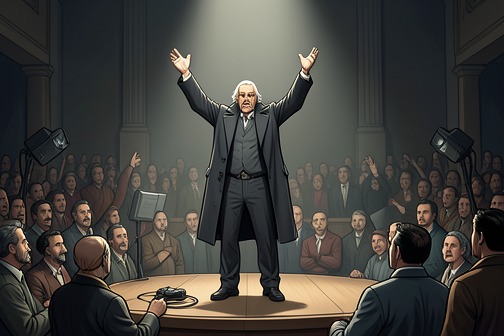
[Lestat](entity:character-recall-character-lestat-1e494e73e33c)’s public disclosure of his vampire identity is a deliberate campaign, not an accidental leak: he turns his own name, history, and supernatural nature into the center of a mass-media spectacle. The project makes him a rock superstar, yet its success brings the hidden vampire world into collision with public fame and provokes warnings from vampires who regard such exposure as a violation of their most fundamental law.
## From secrecy to public spectacle
The campaign combines music, film, and autobiography. Lestat’s first album sells four million copies; MTV plays his video clips repeatedly, and the clips reach audiences in England, parts of Asia, and Japan. Video cassettes of the series also sell worldwide. His autobiography is published alongside the widening public presence of the music project, making his life story another vehicle for his name and voice.
Lestat explains the ambition to [Christine](entity:character-recall-character-christine-0a5574df6664), his young lawyer, as a need to carry his fame beyond the success of the band. He asks her to recruit leading French directors from New York and Los Angeles, find studios, and hire the best young record producers. The venture is to be made in secret until the albums, films, and proposed book can be released together. Christine advises him not to risk his fortune, but his confidence overcomes her caution. The disclosure is therefore carefully staged: secrecy is not abandoned during production, but used to prepare a larger, coordinated revelation.
## The taboo he breaks
The consequences of the project are sharpened by Lestat’s encounter with [Louis](entity:character-recall-character-louis-b60a54ea5311)’s earlier disclosure. At a [New Orleans](entity:location-recall-location-new-orleans-ac6617a07d7e) bookstore, he sees a paperback copy of *[Interview with the Vampire](entity:object-recall-object-interview-with-the-vam-7b53a6f85e48)*, Louis’s account of vampire life. Lestat considers the prohibition against telling mortals about vampires sacred: vampires should not reveal their nature, identify other immortals, or disclose where they live, unless they intend to pass on the [Dark Gift](entity:concept-recall-concept-dark-gift-8ccbb9152cb6). In his view, Louis has gone much further than Lestat’s earlier, limited disclosure to his rock musicians. The book has reached hundreds of thousands of readers and has nearly pointed them toward the place in New Orleans where Lestat slept. Lestat is unsure what Louis knew about that location or what he intended by revealing it.
Lestat’s own campaign knowingly compounds the breach. His published autobiography and films do not merely invite speculation about a fictional monster; they circulate vampire names and history in forms designed for a worldwide audience. In the later account of the project, he wonders whether the films have reached the immortals whose stories they invoke, including [Marius](entity:character-recall-character-marius-64ee8a1791fa), [Mael](entity:character-recall-character-mael-87a192844fad), and [Pandora](entity:character-recall-character-pandora-e833d7b69fc8). He recognizes that Marius could find him despite any precautions, and connects the public telling of the history with his own betrayal of Marius’s trust.
## Threats and the tour
The first direct warnings arrive by telephone during the week before the record goes on sale. The voices reach the band through an unlisted number and a recorded answering machine message, calling Lestat an outcast, demanding that he stop, and challenging him to come into view. The threats arrive despite the precautions surrounding the band: even the autobiography’s publishers have cooperated in keeping the project secret, and Lestat has neither seen nor heard the threatening vampires in New Orleans during the months of recording and filmmaking.
Lestat has the band staying at a plantation house north of New Orleans as they prepare for the first live audience in [San Francisco](entity:location-recall-location-d0db84fe8c04). The threats intensify around the performance. Their callers warn that they will risk a public scandal to punish him if he appears onstage, but Lestat does not see the vampires hunting in San Francisco. He remains sly and silent in the crowded city, while the tour’s public success gathers force around him.
## Fame, isolation, and the performance
After the San Francisco opening, telegrams arrive at the Monterey postbox with news that album sales are breaking records in the United States and Europe. The group can perform wherever it chooses, and Lestat’s autobiography is available in bookstores across the country. He searches the sacks of fan mail forwarded from New Orleans for signs of vampire writers, scrutinizing handwriting for supernatural clues, but finds only mortal devotion. One fan even offers to be a victim and invites him to drink her blood, an instance of the way the public image blurs admiration and vampire lore without proving that the audience understands his actual nature.
In the nights around the tour, Lestat rides through San Francisco thinking about Louis and [Gabrielle](entity:character-recall-character-f84321db0300), and about Marius, whom he believes he betrayed by telling the whole story. He wonders whether the films have reached the people named in them and whether Marius has heard. Against the success of the album and the approaching concert stands a new sense of loneliness: the threatening voices are present, but he has no confirming image of their speakers. The success does not settle the danger or repair the broken trust; it makes the silence around him feel larger.
The public performance nevertheless answers a deeply personal desire. Driving alone with the band’s music playing, Lestat feels the excitement of performing with his mortal bandmates, [Tough Cookie](entity:character-recall-character-tough-cookie-cfeae847bd1a), [Alex](entity:character-recall-character-alex-ad819204cb8d), and [Larry](entity:character-recall-character-larry-e4ec2b6e8fcf). Memories of his earlier nights at [Renaud](entity:character-recall-character-6a83719fd50c)’s theater return, linking the present stage to his past as a performer. At the concert, the crowd chants his name in unison. He raises his black cloak as a signal, shakes out his hair, and lifts the cloak on either side as the audience’s response swells. The scene makes the disclosure both a breach of vampire secrecy and a theatrical triumph: Lestat offers himself as an object of public attention, while the threatened immortals remain unseen.
## Consequences and significance
The episode establishes that Lestat’s publicity has consequences beyond celebrity. His staged revelation wins broad commercial reach and fervent audience attention, but also exposes the names and histories of other vampires to a world from which their community has tried to remain hidden. The anonymous calls turn that breach into an explicit conflict: the underground group threatens punishment and a scandal, while Lestat continues toward the stage.
The event also leaves its central risks unresolved. The crowds and fan letters are mortal, and Lestat does not identify the vampires behind the calls or learn whether the ancient figures he has named have watched the films. He nevertheless understands that precautions cannot prevent Marius from finding him if Marius chooses to look. By proceeding, Lestat accepts the possibility of Marius’s anger as a consequence he deserves, even as the concert’s acclaim confirms the power of the public identity he has created.
Event 37
旧金山Cow Palace演唱会

The [San Francisco](entity:location-recall-location-d0db84fe8c04) Cow Palace concert is the culmination of [Lestat](entity:character-recall-character-lestat-1e494e73e33c)’s public rock-star persona and a deliberate breach of the vampire rule against revealing their kind to mortals. Before fifteen thousand people, he announces that he is a vampire, then addresses the concealed immortals in the audience as well. The concert makes secrecy a spectacle: human fans respond with ecstatic worship, while the vampires remain apart, watching but refusing to approach.
## Causes and Context
Lestat’s concert takes place after he has already crossed the boundary between private disclosure and public exposure. He recalls that vampire custom forbids telling mortals about vampires, naming other immortals, or revealing their lairs. In his view, [Louis](entity:character-recall-character-louis-b60a54ea5311)’s account, *[Interview with the Vampire](entity:object-recall-object-interview-with-the-vam-7b53a6f85e48)*, has gone much further than Lestat’s earlier disclosure to his rock musicians: it has reached hundreds of thousands of readers and may even point toward the place where Lestat sleeps. The book has made secrecy an immediate concern, but the concert changes the scale of the breach by turning Lestat himself into its public subject.
The event is also the product of an intentionally theatrical career. Lestat’s knowledge of performance reaches back to the *commedia dell’arte*, whose actors improvised from familiar roles rather than repeating fixed lines. Later, his troupe continued that tradition while mixing comedy, songs, and other entertainment to avoid violating the state theaters’ monopoly on serious plays. At the Cow Palace, improvisation and spectacle become tools for a different purpose: Lestat uses the concert stage to make his identity unmistakable, rather than to conceal it behind a fictional performance.
## Arrival and Performance
The concert’s scale is apparent before the band reaches the stage. The vast parking lots are overflowing; the hall has been sold out for a month, and disappointed fans are promised outside screens and speakers. The police have approved those arrangements to prevent a riot. Lestat arrives in a motorcade with his musicians ahead of him and Louis beside him in a Porsche. Inside, guards and fans create such a crush that the group struggles to reach the secured backstage area. Lestat brings Louis through the doors with him.
From the dressing rooms, Lestat hears fifteen thousand people chanting and screaming beneath one roof. Through a peephole he sees the crowd filling both sides of the long oval auditorium, with thousands dancing in the open center. As the houselights go out, the audience’s cry swells; cigarette lighters flicker in the darkness. Then the overhead lights strike the performers in crossing beams of silver, blue, and red, and the entire hall rises to its feet. Lestat’s body and costume are part of the scene: he shakes out his hair, opens his black cloak like wings, and discovers that each gesture intensifies the crowd’s response.
The audience chants Lestat’s name in unison. He steps back from the microphone and declares, “I AM THE VAMPIRE LESTAT!” The announcement is not delivered as a private confession or a guarded hint. It is amplified as the central act of a show, answered by a crowd whose roar seems to overwhelm even his words. He then urges the audience to make itself heard and tells them that they love him. The distinction between performer and audience becomes a feedback loop: his gestures provoke louder acclaim, and that acclaim emboldens the performance.
## The Revelation and Its Audience
Lestat repeats the disclosure later in the set, shouting, “I AM TELLING YOU I AM A VAMPIRE!” and declaring himself evil. Yet the moment also reveals that he is not addressing only the human fans. In a pause marked by shame, he recognizes small, pale faces among the larger mass of mortal spectators. He knows that Louis has seen them too. Lestat calls on the real vampires in the audience to reveal themselves, but they remain unchanged while the costumed mortals around them continue to react wildly.
For three hours the performance proceeds amid singing, dancing, and a crowd that repeatedly surges toward the stage. The police presence has to be reinforced, and seats break in the upper corners; cans roll across the floor. The hidden vampires do not come closer, and some disappear. This divided response is the concert’s sharpest consequence within the hall: the mortals turn Lestat’s claim into an occasion for mass excitement, while the immortals treat the same claim as a danger from which distance is necessary.
## Aftermath and Significance
The concert ends with “[Age of Innocence](entity:expression-recall-expression-age-of-innocence-2d480f848775),” the ballad from the final video clip. As the music softens, its drums recede and its electric-harpsichord notes spread through the hall. The ending does not undo the revelation. Lestat has used an immense public performance to announce what vampire secrecy forbids, and the presence of other vampires in the audience confirms that the act has been witnessed by the community whose rules it defies.
The event also brings together two kinds of performance that have shaped Lestat’s life. The improvisational tradition he once admired made roles vivid by letting actors interpret them anew; at the Cow Palace, Lestat turns his own identity into a role announced at full volume, while insisting that the claim is true. The crowd’s adoration lends the declaration power, but the hidden vampires’ refusal to approach exposes its cost. The concert is therefore both a moment of celebrity triumph and a public rupture with the conditions that had kept vampire identity concealed.
Event 38
旧金山演唱会后的吸血鬼袭击
The vampire attack after the [San Francisco](entity:location-recall-location-d0db84fe8c04) concert transforms a danger gathering around [Lestat](entity:character-recall-character-lestat-1e494e73e33c) and [Louis](entity:character-recall-character-louis-b60a54ea5311) into an open confrontation amid a crowd of mortals. Three pursuing vampires threaten them at the venue and on the freeway, but an unseen force repeatedly destroys the attackers. [Gabrielle](entity:character-recall-character-f84321db0300)’s sudden arrival provides an escape, though pursuit ends in a crash; afterward, Lestat, Louis, and Gabrielle stand together beside the burning car, alive and reunited but with the source of their protection still unknown.
## Causes and Background
The attack follows Lestat’s public revelation of the vampires and the concert, where the exposure of their existence has drawn hostile immortals into the open. The danger is not confined to an isolated encounter: a crowd surrounds the vehicles, and the attackers move through the commotion toward Lestat and Louis. Earlier, Lestat had recognized the peril of telling mortals about vampires, a secrecy rule he regarded as sacred. The concert’s aftermath gives that breach an immediate, physical consequence: the secret world enters a public space, where vampires and mortals are caught in the same unfolding crisis.
The attackers appear as a trio, including a tall male in black leather associated with motorcycle riders, another male, and a woman. Their approach is forceful and coordinated. The tall vampire lifts a Porsche despite the people holding onto it, while one attacker reaches Lestat from behind. The threat develops amid sirens, whistles, police warnings, and a crowd pressing around the vehicles, making escape hazardous even before the supernatural attackers strike.
## The Assault at the Venue
As the attackers close in, the concert crowd begins to panic. Lestat steadies the Porsche before it tips over, while Louis fights off the vampire who has seized him. A scythe flashes above the car, and another appears nearby. The weapons and the vampires’ assault turn the crowd’s confusion into a danger shared by everyone around them: mortals scream and shove as a policeman uses a loudspeaker to urge them to clear the area.
The attack is abruptly reversed by a power neither Lestat nor Louis has used. One vampire bursts into flames; two more are consumed in separate sudden blazes. The mortals flee in panic, and other immortals escape at supernatural speed. Lestat and Louis are left stunned by what they have witnessed. Lestat recognizes that neither of them caused the destruction and knows only one immortal who could possess such power, but the scene does not identify that figure as its source.
## Gabrielle’s Intervention and the Chase
A small white hand reaches from the Porsche, and Gabrielle calls out in French for Lestat and Louis to get inside. Her arrival shifts the immediate problem from facing the attackers to escaping the scene. Lestat recognizes her and is overwhelmed by her return, but Gabrielle keeps her attention on driving. When he asks whether she burned the vampires, she denies having done so. Her presence therefore rescues them without explaining the force that destroyed their pursuers.
Gabrielle drives away from the auditorium rather than toward [Marius](entity:character-recall-character-marius-64ee8a1791fa), despite Lestat’s objections. She points out that a vehicle is following them: a large black van carrying four vampires. Lestat and Louis are now fleeing a renewed pursuit, and the earlier protection has not made them safe. The distinction between the unseen force and Gabrielle matters here: she is plainly the driver and their rescuer, but she does not claim responsibility for the attackers’ sudden combustion.
## Crash and Aftermath
The pursuing vehicle strikes the Porsche with enough force to send Lestat over the side of the freeway as the car sails ahead. Gabrielle gets out before it hits the ground; she and Lestat roll down the grassy slope as the Porsche overturns and explodes. Lestat calls for Louis, who escapes through the rear window and reaches the embankment. [Lestat and Gabrielle](entity:relation-recall-relation-lestat-and-gabrielle-fdeaba11ef28) help beat out the flames on his clothing, and the three are briefly together beside the wreck.
The vampires from the van descend from the freeway edge and close in again. When the first attacker approaches with a scythe, the same blinding combustion strikes. The remaining pursuers retreat beneath the freeway, and Louis urges Lestat not to follow. With the burned attacker dead and the others vanished into darkness, the immediate assault ends. The night grows quiet apart from traffic overhead; Louis is soot-stained, and Gabrielle appears in the ragged, boyish clothes she has worn before. The encounter closes on a reunion rather than an explanation: the three stand together, but the identity and purpose of the power that repeatedly saved them remain unstated.